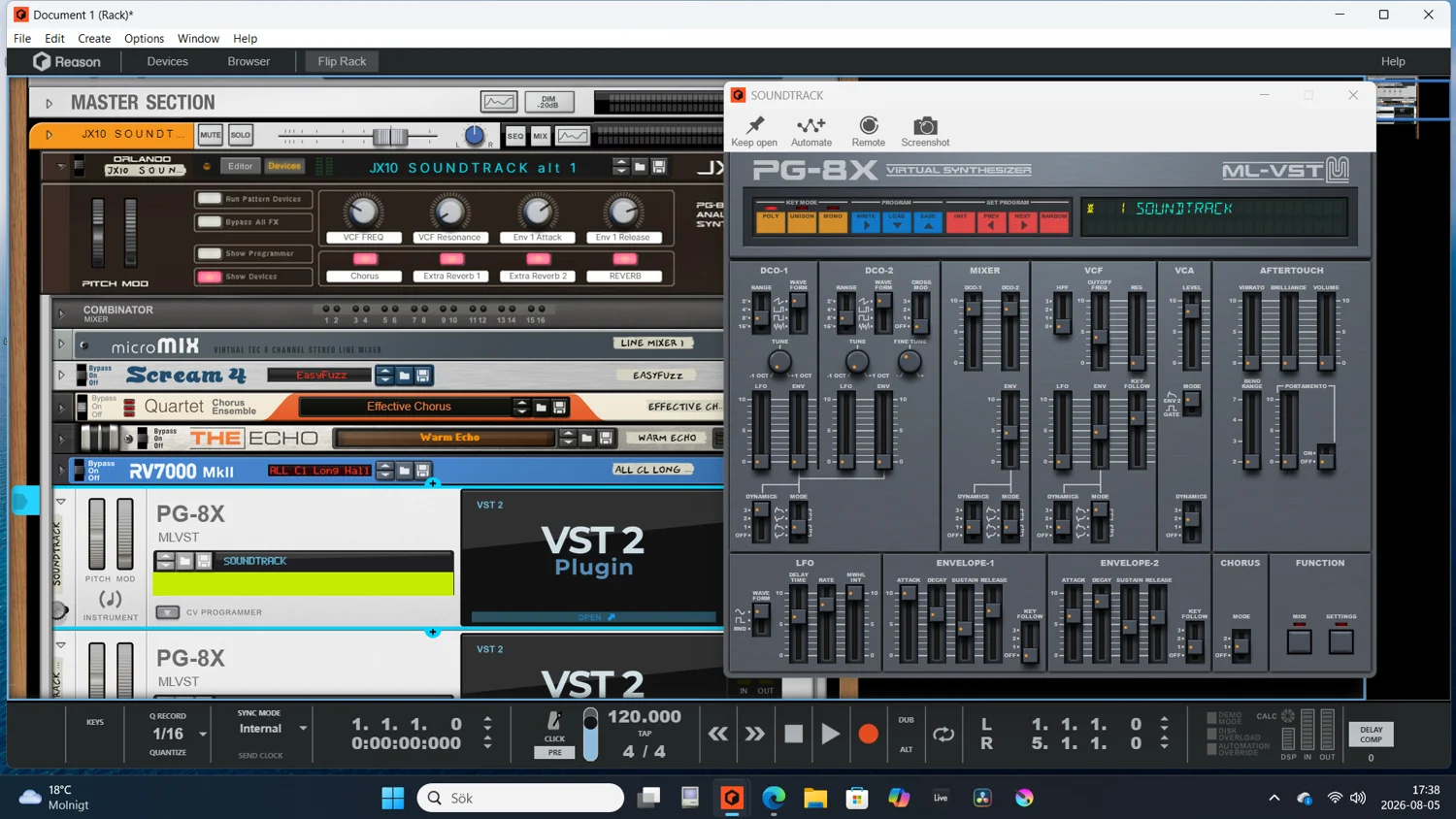


Way Beyond PG-8X
THE companion to PG-8X
- • All of the JX8P and JX10 sounds
- • Over 500 Combinator patches
- • Sample library for layers
The JX Legacy in Short
Historical Background
In 1985, Roland introduced the JX‑8P — their first velocity‑sensitive analog synthesizer.
Although fully analog and limited to six voices of polyphony, its clever cross‑modulation modes allowed it to compete with the crystal‑clear digital tones of the 16‑voice Yamaha DX7. The DX7 reshaped the entire synth market, contributing to the downfall of several iconic manufacturers: Oberheim, Sequential, Moog, and ARP all disappeared during those years.
The JX‑8P was intentionally designed with a button‑driven front panel that visually echoed the DX7’s aesthetic. To restore hands‑on control, Roland offered the optional PG‑800 programmer, giving direct access to all synthesis parameters and bringing back the tactile Prophet‑5 / Jupiter‑8 style workflow that many players preferred.
Evolution of the JX Line
In 1986, Roland released the JX‑10 Super JX and its rack‑mounted sibling, the MKS‑70. Both instruments were built around two complete JX‑8P voice boards and featured a more advanced internal patching architecture, enabling rich, layered, and highly expressive sounds. Aside from the later JD‑XA and JD‑Xi — which are hybrid designs — these were effectively Roland’s final true analog synthesizers.
The digital D‑50 that followed in 1987 reused many JX‑10 concepts and added pulse‑width modulation inspired by the Alpha Juno series. In practice, this was virtual analog synthesis before the term existed. Much of the refined character of the analog JX line became slightly more “Casio CZ‑like” when translated into early digital form — but that is another story entirely.
The JX Legacy Inside Reason
Today, these fantastic instruments can coexist once again inside Reason, thanks to the excellent — and free — PG‑8X plugin.
Way Beyond PG-8X includes every original patch from the JX‑8P and JX‑10, along with the extensive library of sounds programmed by Bitley on the original hardware.
Each tone has been carefully recreated and expanded using Martin Lüders’ PG‑8X VST plugin — a tool so faithful that A/B tests against original JX‑8P and JX‑10 units produced remarkably consistent results.
Note: Because PG‑8X is a VST instrument, this ReFill requires the full version of Reason. It cannot be used in Reason Rack Plugin mode, as the VST must reside inside the Reason rack to function.
Enhanced Instruments Through Combinator
Reason’s Combinator allowed us to push the sound far beyond single patches — creating deep, stereo, multi‑layered instruments and integrating a large included sample library for striking results. As a respectful nod to Roland’s original designers, we named our custom module MKS‑770.
macOS Installation Notice
Before using the WB PG‑8X ReFill, ensure that the PG‑8X plugin works correctly on your system. The sound bank depends heavily on the plugin; without it, much of its value is lost.
On macOS, the plugin may need to be manually de‑quarantined. If PG‑8X fails to load, try the following:
Remove quarantine attribute
Open Terminal, navigate to your VST folder, and run:
xattr -d com.apple.quarantine
Replace `` with the actual PG‑8X plugin file.
If the command fails, try:
sudo xattr -d com.apple.quarantine
You will then be prompted for your macOS user password.