Receive, collect and distribute
MultiPlay accepts native Player-chain notes and four monophonic Note/Gate CV sources. All to Host can forward every incoming occurrence, including CV input, to the attached instrument. For a collector setup, disable ordinary lanes and enable All to Host; native input is forwarded too.
Choose the destinations
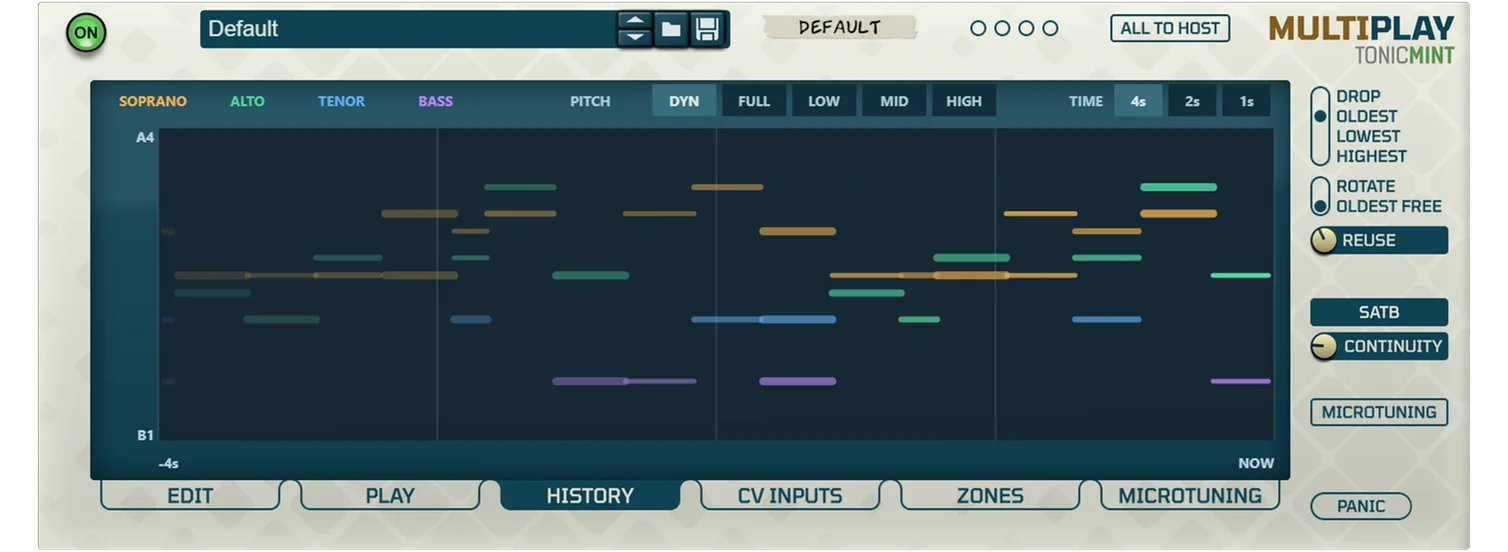
Each physical lane supplies Note, Gate, Mod and Bend outputs. Route notes across 15 physical lanes and the native HOST slot, using Rotate or Oldest Free allocation. Choose Drop, Oldest, Lowest or Highest behavior when an eligible pool is full. Reuse protection prefers other free destinations when release tails may still be sounding.
Shape playable ranges
Four zones combine inclusive note and velocity ranges. Use them for keyboard splits, velocity-based routing and restricted instrument ranges. Optional SATB classification assigns incoming notes to Soprano, Alto, Tenor and Bass pools without adding harmony notes or waiting to collect a chord.
Tune external voices
A twelve-pitch-class cent table and a global Amount control shape microtuning. Physical destinations require Bend CV wiring and a matching receiving-instrument bend range. Native HOST note events do not automatically carry independent per-note tuning.
See and modulate the performance
EDIT, PLAY, HISTORY, CV INPUTS, ZONES and MICROTUNING show different aspects of the same routing setup. Audition helps test connections. Additional CV outputs describe group activity, density, last velocity, register and spread of ordinary allocated notes.
Routing essentials
External instruments normally need both Note and Gate. A zone can explicitly allow Gate-only destinations for fixed-pitch uses. The device produces note and control signals, not audio; save instruments and cables in a Reason song or complete rack setup.