A few notes can carry the whole scene
A clear plucked hook, a bending melody or a soft pattern under a beat: Acukoto brings thirteen modelled silk strings and a resonant paulownia body into your Reason rack. Play with a tsume pick or a bare finger, then shape the attack, the hand movement and the space around the instrument. Every note is generated in real time, with no recorded sample library.
The strings and body answer each other
Each string has its own movable bridge, called a ji. The model follows vibration in two directions, on both sides of that bridge. The ji can rock and rise on its feet, carrying the string’s energy into the body and letting other strings answer in sympathy. The body includes the bending and twisting of its wooden shell, the motion of its arched top and the air resonating through its back openings. These are connected parts of the sound: a pluck can leave more than one string ringing.
The model draws on published measurements, material properties and comparisons with professional recordings, with fitted and estimated values where measurements are unavailable. Silk-string stiffness and loss help shape the changing brightness and decay. It is an interpretation of the instrument’s construction and playing behaviour, with controls that let you explore it directly.
Put a hand behind the phrase
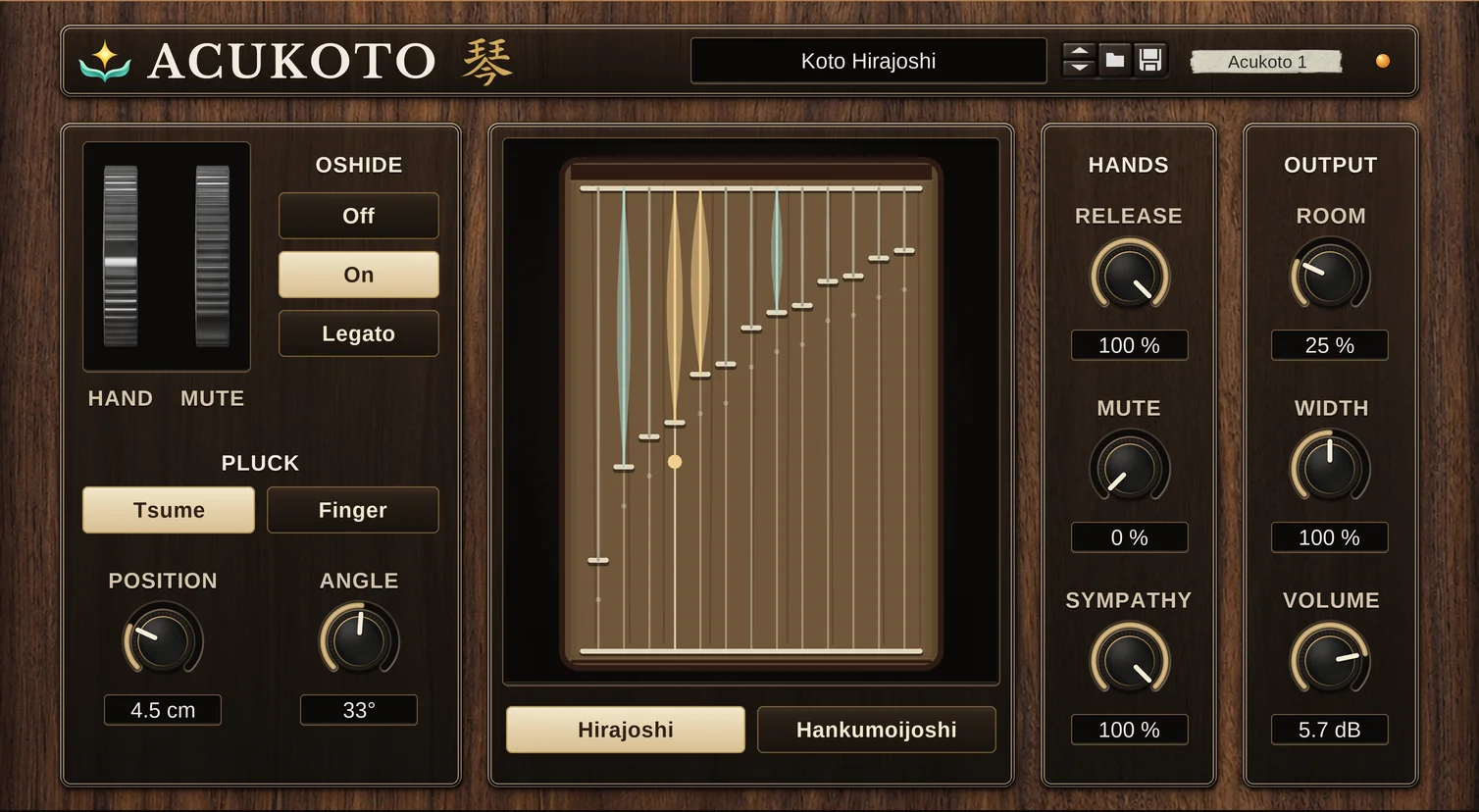
Choose the sharper release of a tsume or the softer contact of a finger. Position moves the stroke from 2 to 12 cm from the fixed bridge; Angle changes the direction of the pluck. Harder strokes release more brightly, and small variations in force, position and angle keep repeated notes moving. A tsume re-pluck leaves the untouched stretch ringing into the new attack.
Oshide On lets suitable chromatic keys press a string behind its ji before plucking it. Legato adds a sliding press between suitable notes in a single line, without another pluck. With Oshide Off, those keys change pitch by moving the bridge instead. The HAND wheel acts on the last plucked string: press upward by up to a whole tone or pull downward by up to a semitone, then return to centre. Use small movements for ornaments or a slow rise into the next note.
Release controls the ring after key-up. Mute and the modulation wheel let you damp the strings as you play, while the sustain pedal keeps plucked strings open. Sympathy sets how freely the unplayed strings respond.
Add a rhythm from the same instrument
The twelve keys below the lowest string play body hits: palm, knuckle and hard-rap gestures at different places on the top, side and back. Velocity sets the intensity, and the contact feeds the same resonant body that carries the strings. A hit can set the strings ringing in sympathy, giving the rhythm and melody a shared resonance. Try a sparse wooden pulse between melodic notes or a sharp accent at the end of a phrase.
In Reason’s note names, the body hits occupy D1-C#2 and the open strings run from D2 to A4. Notes above the string bank extend the instrument by moving a bridge; that extra reach is a creative extension of a koto’s range. The lower A-1-C#1 keys are silent. A rear-panel keyboard diagram makes the zones easy to find.
Tune the colour, then place it in the mix
Choose Hirajoshi or Hankumoijoshi. Hirajoshi’s open-string tuning follows published measurements of professional players, preserving its characteristic interval relationships. A modelled ORTF pair of cardioid microphones hears the radiating body and its floor reflection. Room adds space, and Width takes the image from mono to a wider spread.
Nine patches provide starting points for both tunings, finger playing, near and far plucks, damped attacks, a close dry sound and a wider hall. The animated koto display shows the bridge positions and strings that are held, fading or ringing in sympathy. Note and Gate CV, automation and Remote mapping connect the performance to your rack. Rear oversampling offers 1x, 2x and 4x processing. Requires Reason 14 or later.
Version history
0.18.0
- Twelve velocity-sensitive body hits arranged across the octave below the lowest string, using palm, knuckle and hard-rap gestures.
- More even touch balance across the strings, with two factory patch output trims updated.
- A rear playing-range diagram showing the silent keys, body hits, strings and extended upper range.
- Engine processing improvements, alongside the thirteen-string model, two tunings, expressive hand controls and nine factory patches.