Overview
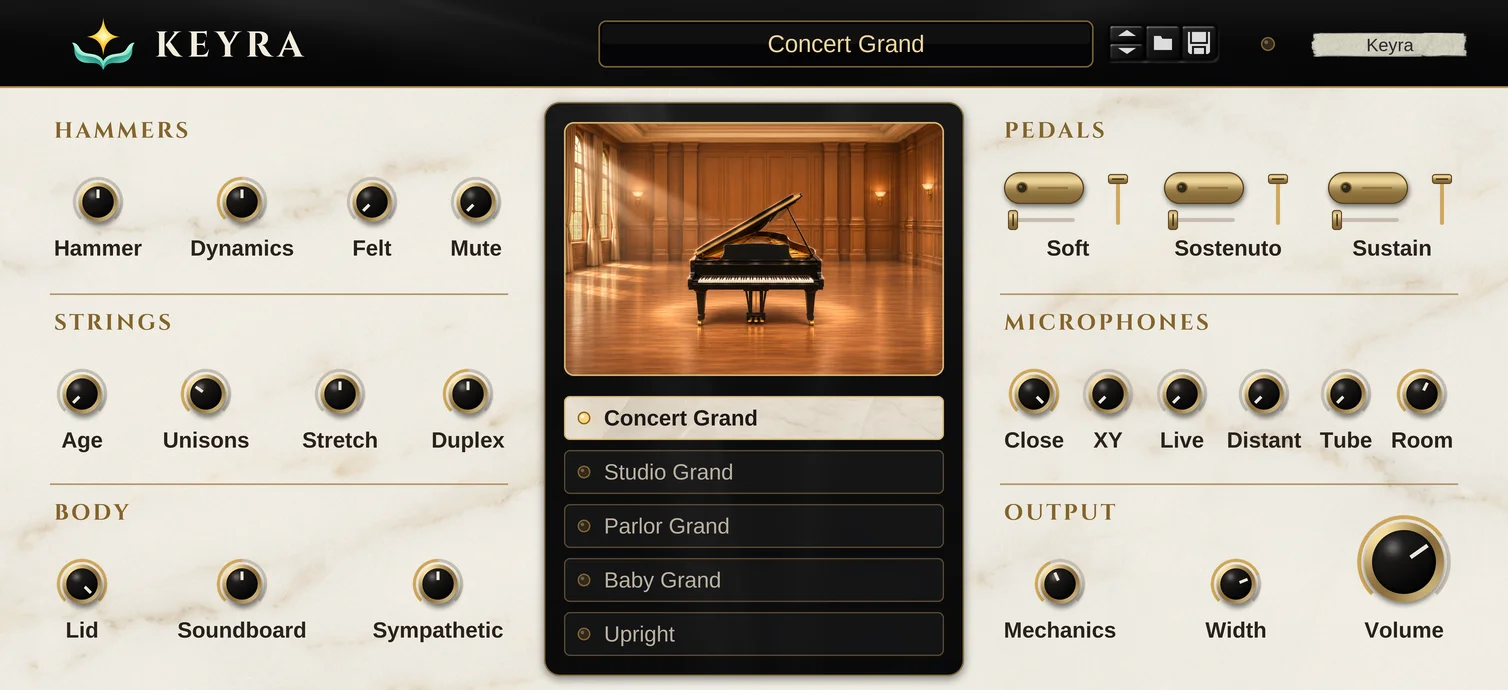
Keyra is a piano for the Reason rack that plays no recordings. Felt hammers strike the strings, the strings of each note share a bridge, and a soundboard carries the sound to five microphones, so the tone follows how you play: a harder blow opens it up, a key struck again meets a string that is still moving, and no two strikes land quite alike. Choose a concert, studio, parlor or baby grand or an upright, voice its hammers, strings and body from the front, and play it with half-pedals, sostenuto and soft pedal.
Key features
- Five modelled pianos: a concert, studio, parlor and baby grand and an upright, with no samples
- A harder blow opens the tone, not only the volume, from the softest key to a hard fortissimo at velocity 127
- No two strikes quite alike: each blow differs a little in level and in where the felt meets the strings
- Sustain, sostenuto and soft pedals, each with an On switch and an amount, so half-pedalling shortens the ring; hold C0, C♯0 or D0 for the pedals on a keyboard without them
- The modulation wheel and Mute lay felt on the sounding strings, even on held keys
- Voice the piano from the front: Hammer, Dynamics, a practice Felt, Lid, Soundboard, Sympathetic strings and Duplex
- Age the strings, spread each note’s unison from pure to a bar piano and set the tuner’s Stretch; Tuning covers 400 to 480 Hz on the back
- Keys land and dampers fall audibly, and Mechanics sets how loud
- Five microphones: a close pair over the hammers, an XY pair at the lid, a pair in the room, a wide Distant pair across it and a Tube microphone over the strings, each with its own level, polarity switch and output sockets on the back
- Room sets the size of the room around the microphones, from a small room to a concert hall, and Width narrows the image to mono
- Note CV and Gate CV inputs for Reason’s sequencers
How to use it
Find Keyra in the Instruments section of Reason’s browser, under Keys, and create it; it opens with Concert Grand. Play at different strengths, then try the pedals: press On and set the amount with the fader beside it. Pick another piano from the list in the middle, move Room from a small room to a hall and turn up XY, Live, Distant or Tube to blend microphones with the Close pair.
Tip: cable the Distant sockets on the back to their own channel and balance the room against the close sound on Reason’s mixer.
What’s included
- Keyra Modelled Piano Rack Extension
- 13 factory patches: Concert Grand, Studio Grand, Parlor Grand, Baby Grand and Upright as built, and eight variations, among them Felt Nocturne, Old Parlor and Bar Piano
- Download size: about 23 MB
- PDF user guide
Specifications
- Device type: Instrument
- Outputs: main stereo pair (left and right), a stereo pair each for the Close, XY, Live and Distant microphones and a mono Tube output
- CV inputs: Note CV and Gate CV
- Rear panel: Tuning and each microphone’s polarity switch
- Automation of the panel’s knobs and pedals; Remote mapping of every control, with a travel slider under each pedal
Requirements
Reason 14 or later.
Version history
- 2.24.4: Sustained chords and several microphone outputs at once use less processor time, and resetting during a pitch bend restores the strings’ tuning. The user guide explains gain staging for the microphone outputs.
- 2.24.3: The first arrival and the sustain of upper notes agree on every microphone, F♯5 on the Concert Grand’s Distant pair among them.
- 2.24.2: Each microphone output keeps its own voicing for every key. Struck strings keep their sympathetic motion, the duplex strings answer with the dampers down, and a dense chord can use all 88 hammers. The Tube microphone takes its direct and reflected sound from one capsule, and upper keys such as the Upright’s C7 attack without a spike.
- 2.24.0: Initial release