Overview
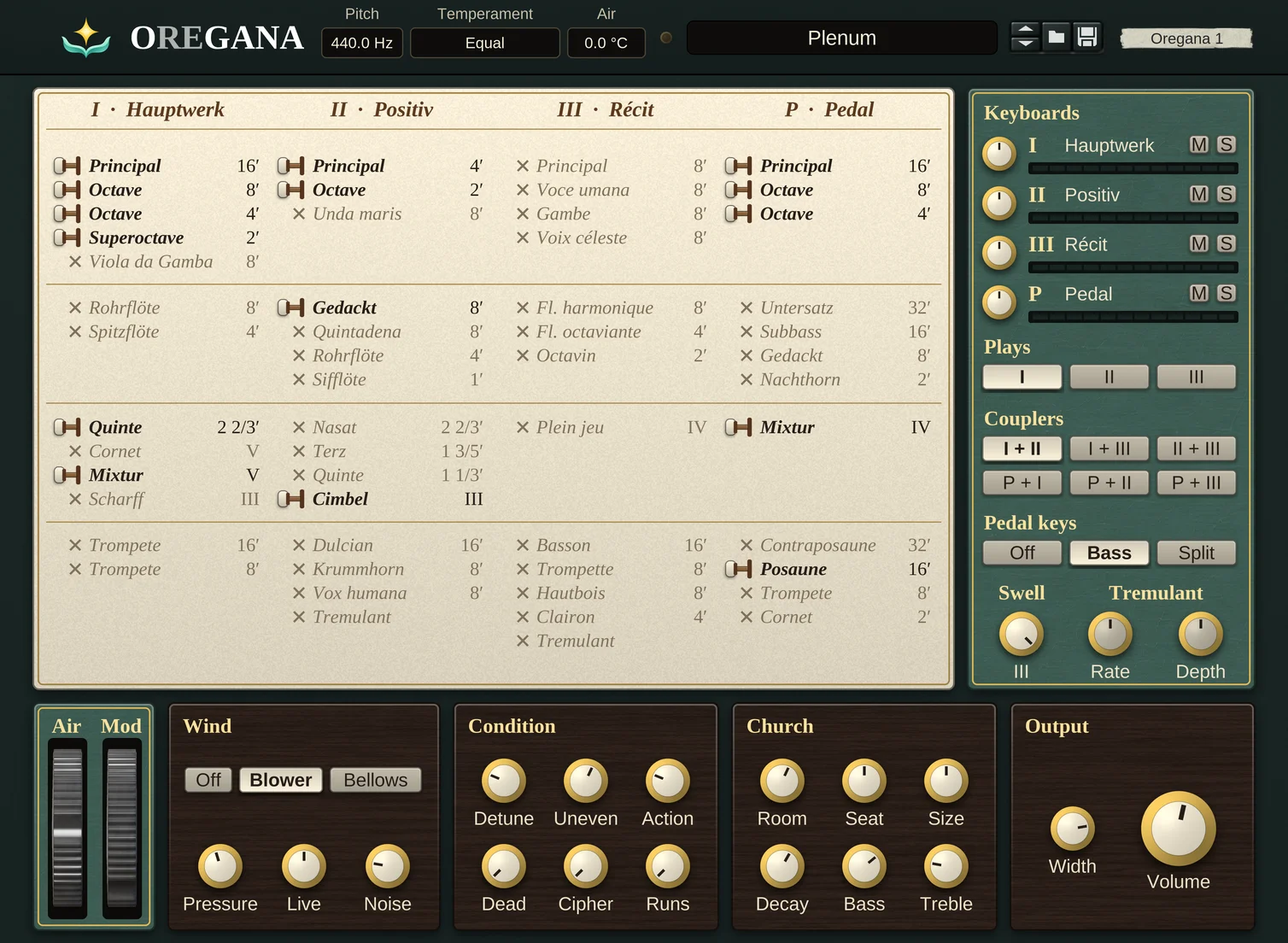
Oregana is a church organ you register yourself. Draw a Principal, add the Octave above it, then a Mixtur, and the plenum builds as it does at a console; draw a Trompete and the reeds cut through. Every pipe is a physical model that takes wind from its division’s reservoir, so a big chord leans on the wind, a stop slides on rather than switching, and no two pipes are quite alike. Push the mod wheel to bring the whole organ in stage by stage, as a crescendo pedal does, and close the Récit’s swell box with an expression pedal.
Key features
- 51 stops on a German Hauptwerk and Positiv, an enclosed French Récit with its Voix céleste, Flûte harmonique and Trompette, and a Pedal down to 32’
- The stops are sorted by the kind of pipe, principals and strings, flutes, mixtures and reeds, and each shows its division and pitch
- Six couplers join the manuals and the Pedal, and two tremulants beat on the Positiv and the Récit
- One keyboard plays the manual you choose, and its lowest key held, or every key below a split, plays the Pedal
- The pitch wheel warms and cools the air: the flue pipes follow it and the reeds stay, so the organ drifts out of tune with its reeds, as on a warm day
- Wind comes from a blower or a calcant treading the bellows, with its pressure, how live it is and how loud its noise
- Condition ages the organ: pipes drift from their tuning, the voicing grows uneven, the action wears, and a few pipes fall silent or cipher
- Church seats you along and across the nave and sets the building’s size, its reverberation in the bass and treble, and the width
- A level knob, a meter, Mute and Solo for each division, and a dry stereo output for each on the back
- On the back: the pitch of a1, the air’s temperature and five temperaments from equal to meantone, shown again in the front header
- Note and Gate CV inputs let a Matrix or an RPG-8 play it
How to use it
Find Oregana among the instruments in Reason’s browser and create it; it opens on Plenum. Play a hymn, push the mod wheel up to bring in more of the organ, then draw and push in stops yourself. The patches go from single registrations to whole organs: chapels, churches and cathedrals, and organs from eight countries and regions, each in a building of its own.
Tip: Pedal Keys starts on Bass, so the lowest key you hold also plays the Pedal; choose Split and every key below the C an octave under middle C plays the Pedal alone.
What’s included
- Oregana Church Organ Rack Extension
- 77 patches: 17 registrations from Principal 8 to Tutti, 20 whole organs in Chapel, Church and Cathedral folders, and 40 organs from Bohemia, England, France, Germany, Italy, the Netherlands, Saxony and Spain
- Download size: about 32 MB
Specifications
- Device type: Instrument
- Outputs: main stereo pair, and a dry stereo pair for each of the Hauptwerk, Positiv, Récit and Pedal
- CV inputs: Note and Gate
- Performance: the mod wheel is the crescendo roller, expression the swell pedal and the pitch wheel the air’s warmth; an organ has no sustain pedal, and Oregana takes none
- Processor load grows with the stops drawn: a few stops ask little, and the full organ sounds several thousand pipes at once
- Automation of the playing controls; Remote mapping of every control, Pitch, Temperament and Air included from the front header
Requirements
Reason 14 or later.
Version history
- 0.12.5: Harmonic flutes speak reliably at low wind and when half drawn, the treble Vox humana is tuned to its resonator, reeds start and stop more smoothly and the tremulant stops when the wind is off. A ciphering pipe now sounds only while keys are held and closes within a second of letting go, so no setting leaves a note hanging. Pitch, Temperament and Air are shown in the front header, where they can be mapped to a Remote surface.
- 0.12.3: Reason’s master tuning reaches both ends of the Pitch range, and repeated notes attack the same at every buffer size. A key below the Pedal’s compass leaves a held bass sounding, and several stops changed at once make one action noise.
- 0.12.2: Every reed is led by its tongue, so the reeds speak later and brighter and the Krummhorn has its octave. Flue pipes breathe before they speak, the tremulant is a motor spilling wind, and the Récit’s box answers its pedal as a wooden swell box does. Stops and wind change cleanly while keys are held, and each division’s output fades when the track is muted.
- 0.9.0: Each division has a Mute and a Solo, its level runs from −24 to +24 dB, and its own output on the back carries its pipes dry. Every patch loads at 440 Hz. The sequencer’s Mute and Solo silence the organ, and every setting can be mapped to a Remote surface under a readable name.
- 0.8.0: Each division has a level knob and a meter, and the stops are laid out by family and division. Similar stops sound less alike and the trumpets are gentler, in a darker ebony and gilt finish.
- 0.6.2: Initial release