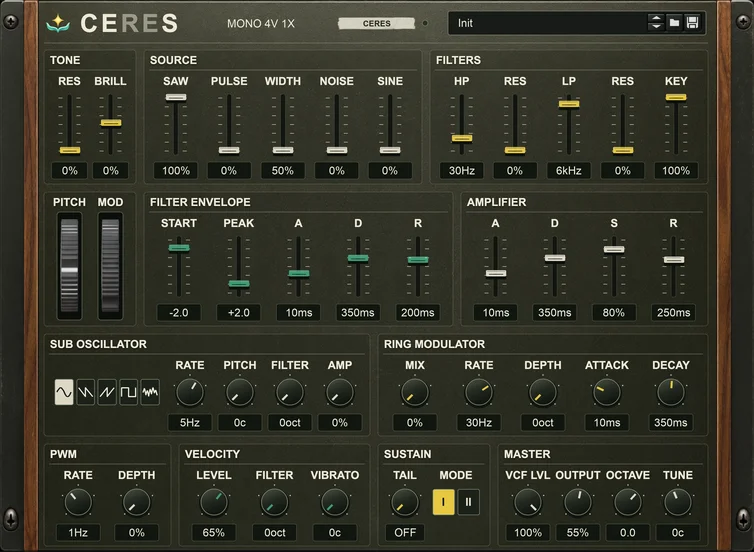
Give your chords a life of their own
Ceres brings a CS-50-inspired circuit model to the Reason rack: warm chord beds, expressive brass, rounded bass, delicate plucks and metallic leads. Mix saw, pulse, sine and noise, then play the filter, envelope and performance controls directly from a clear, hands-on panel. Every sound is synthesized in real time, with no sample library.
The detail is in the interaction
Ceres models the behaviour of interconnected circuits: oscillator reset and waveform shaping, nonlinear OTA filters, capacitor envelopes, shared control lines and the output stages. Ceres retains oscillator phase and circuit charge across note changes, so repeated notes develop from the instrument’s existing state. The sine has the harmonics of a modelled shaping circuit, and pulse width responds to the oscillator’s reset timing. Even the noise source includes the bandwidth and slew behaviour of its amplifier model.
The resonant high-pass and low-pass filters have separate cutoff and resonance controls. Their shared control circuit lets the voices subtly influence one another as envelopes and modulation move. Source loading also follows which saw and pulse sources are enabled. These small interactions give you colour to explore as you build a patch. Use the filter envelope’s independent start and peak levels for swelling brass, hollow plucks and evolving pads; BRILLIANCE and RESONANCE make broad performance changes across the filters.
Choose how much character each voice carries
Each voice is a modelled board with its own variations in tuning, filter response, envelope depth, envelope timing and amplifier balance. Five rear-panel tolerance controls let you adjust those differences, alongside pitch drift, voice spread and a temperature-offset control. Keep a chord focused or let the voices diverge gently. The factory bank uses restrained 0.3-cent drift, with 0.5-cent voice spread, for subtle movement in sustained notes.
From a gentle pulse to a metallic sweep
The SUB oscillator offers sine, falling saw, rising saw, square and filtered noise for pitch, filter and amplitude movement. A separate PWM oscillator keeps pulse-width motion independent. The swept ring modulator has its own rate, depth, attack and decay: use it for shivering keys, bell-like attacks or an unstable lead. Its model includes the balanced multiplier’s saturation, signal leakage and coupling, plus the interaction between its mix control and the expression circuit.
Patch audio into rear EXT IN to replace the SUB waveform with a signal from your rack. It becomes a modulation source for the selected SUB destinations, passing through a modelled preamp with bandwidth, slew and clipping behaviour. Try a rhythmic source for animated textures or another oscillator for more complex motion.
Play the expression into the part
Velocity can shape level, filter, vibrato and wah. Front-panel pitch and mod wheels put bends and vibrato under your hand. Rear EXPRESSION, optionally controlled by CC11, follows an expression-network model that changes the tonal balance as you close it. Portamento and glissando act on the pitch path feeding the oscillator and filters. Sustain I holds released-note pitch; Sustain II lets released voices follow later notes, opening up sliding chord textures.
Make room, or fill the stereo field
Choose 1-16 voices per layer and 1x, 2x or 4x processing quality. Mono output keeps a single layer centred; Double runs two independent modelled layers of the same patch, with adjustable detune and stereo spread. Build a compact bass part or a wide pad, then save sound, performance and rear-panel settings together in a native Reason patch.
Start playing, then make it yours
The 23-patch bank includes Init, nine modern basses, plucks and pads, and thirteen Classic Estimates covering strings, brass, flute, electric piano, clavichord, harpsichord, guitar and funky tones. The Classic Estimates are authored interpretations of classic preset recipes. Note and Gate CV inputs connect to Matrix, RPG-8 and other rack sequencers, while automation and Remote mapping bring the controls into your production workflow.
Version history
1.1.4
Changes since 1.0.3:
- Refined shared filter-control interaction, note allocation, ring-modulator/expression behaviour and portamento response.
- Refined amplifier-control smoothing and the EXT IN preamp model, including its bandwidth and slew behaviour.
- Added front-panel pitch and mod wheels, an expanded 8U layout, clearer readouts and rear Note/Gate CV inputs with legato and retrigger handling.
- Reduced factory drift to 0.3 cents for steadier sustained notes, with small Brass I and Flute level adjustments to retain chord headroom. Explicitly saved tuning values remain intact.
- Made board variation consistent on Reset Device and added processing optimizations for playing, idle and Mono modes.
1.0.3
First Reason Shop release. Includes the circuit-modelled engine, the 23-patch bank with thirteen Classic Estimates, velocity and expression-pedal response, external SUB modulation through EXT IN, and Mono or Double output.