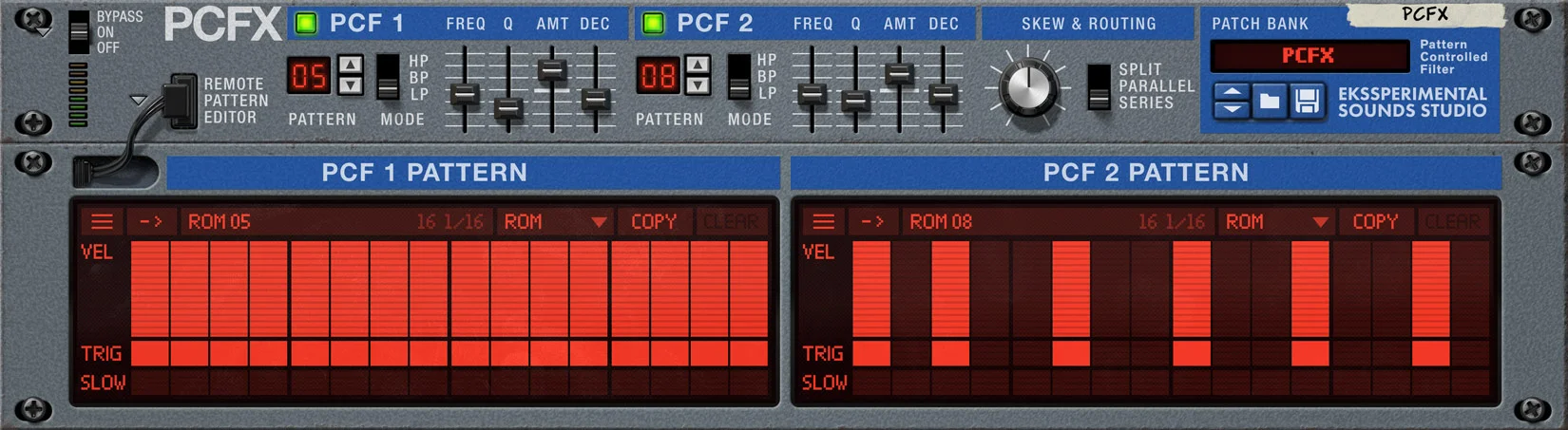


PCFX Pattern Controlled Effect
Rhythmic Filter
- • 55 Classic PCF Patterns + Euclid & Turing
- • Two Pattern Controlled Filters, 12/24 dB
- • Play Melodies on the 24 dB Resonance
Audio examples
A classic, reborn!
PCFX combines two pattern-controlled filters in one rack effect, based on the classic PCF and its 55 original patterns with added USER editable patterns and generative pattern modes. Each step fires an envelope that opens the filter and lets it fall back, making the filter play a rhythmic part in your track. Use it for gated drums, pumping rhythms, stepped sweeps on pads and basslines, or tune the 24 dB resonance to play melodies directly from the filter.
Filters
Each PCF has LP, BP and HP modes with a 12 or 24 dB/oct slope. FREQ sets the base cutoff, while AMT controls how far each step moves it, from −100 % to +100 %. Decay controls the character of the movement, from percussive and short, to pumping at low settings or sweepy or stepped sample-and-hold at the top. Q controls the resonance, from subtle emphasis to strong resonant peaks.
Routing & Skew
The two PCFs can run in Series, Parallel or Split. SKEW behaves differently in each mode: in Series it spreads the two cutoffs in opposite directions, up to an octave per side; in Parallel it pans the PCFs apart; and in Split it places PCF 1 on the left and PCF 2 on the right while cross-modulating their filter movement.
Pattern Banks
Each PCF has four pattern banks. ROM contains the 55 classic patterns, ranging from even rhythms and simple sweeps to complex grooves and 32nd-note figures. 16 patterns have odd lengths such as 3, 7, 19 or 29 steps, allowing them to drift against the bar. USER provides 32 slots per PCF for your own patterns, while EUCLID and TURING generate patterns automatically.
Patterns are locked to the song position, so changing a pattern at bar 9 starts it at the step it would have reached by then. Direction can play patterns forward, reversed, back and forth, or in a seeded random order.
Euclid & Turing
EUCLID distributes a number of hits as evenly as possible across 1–32 steps, with controls for rotation, chance, slide marks and five velocity shapes. TURING is a looping random generator with separate rings for velocity, trigs and slow/slide. Each ring has its own lock, controlling how often its pattern is rewritten.
Both generators are seeded, so the same settings always produce the same pattern. Use COPY to clone a generated pattern into a User slot, where it can be edited step by step.
Remote Pattern Editor
Fold out the editor to view and edit both patterns. Each step has a velocity value, TRIG and SLOW/SLIDE mark. The mouse editor provides draw modes for held levels, random bands, fixed levels, straight lines and smooth curves.
Set LENGTH from 1 to 32 steps and RATE from 16/1 to 1/64. COPY works from every bank, while PASTE writes into any User slot, including slots on the other PCF.
Note Mode & 24 dB Resonator
Switch Vel To from ENV to NOTE and pattern velocities become pitches within a chosen root, scale and range, turning the filter into a playable melodic voice.
In 24 dB mode with Q near maximum, the filter becomes a tuned resonator. Each step pings the resonance, with a decay time from 0.1 to 4 seconds. SLIDE steps tie and glide to the next note, while Gate controls the note length. With FREQ set to A, PCFX can play tuned melodies on its own.
Attack
Fast filter jumps can produce a click. ATTACK adds a 0.1–10 ms attack to soften the transition while retaining the punch. Steps marked SLOW can use a soft attack of up to 1 second. Set ATTACK to OFF for the original instant response.
CV In & Out
Each PCF has its own CV section on the back: a FREQ CV input with trim, MOD OUT for the envelope or note pitch in NOTE mode, TRIG OUT for a trigger per step or a gate in NOTE mode, plus CLOCK OUT, CLOCK IN and RESET.
With CLOCK IN patched, each pulse advances the pattern by one step, allowing one PCF to follow an external clock while the other follows the song. A shared SKEW CV input with trim is also provided.