Two operators, plenty to say
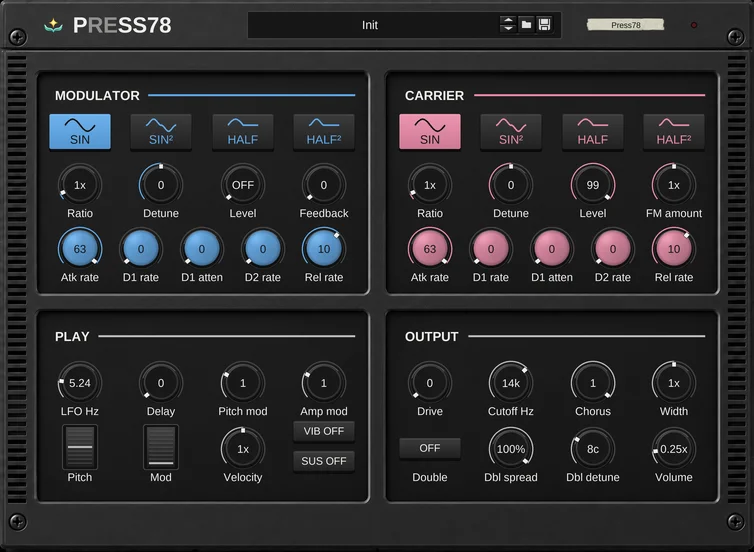
Build a delicate tine, a hollow bass or a bright metallic pluck from two operators with four waveform families each. Ratios, feedback, fine and coarse detuning, separate envelopes and key scaling let you shape both the attack and the way a note changes as it fades. Velocity can alter volume and FM intensity independently: play softly for a rounder phrase, then dig in for a brighter accent. The blue modulator and pink carrier controls make that relationship easy to follow.
Character runs through the instrument
Press78 grew out of research into the PSS-780 and its YM3420 sound chip. Its Original pitch option uses reconstructed firmware pitch commands, while the factory patches also use firmware-derived velocity and per-key level tables and the keyboard’s voice-allocation behaviour. These details affect how a phrase responds across the keyboard and how repeated notes replace their previous releases.
The FM core runs at the researched YM3420 chip rate. On bright, high notes, upper harmonics fold into the distinctive inharmonic pitches associated with that clock. Chip-clock timing also shapes vibrato delay and portamento. A recording-supported triangle vibrato and editable clock variation offer further movement. Press78 combines these researched behaviours with its own synthesis and circuit models; it is a behavioural interpretation of the instrument.
Stereo with two different kinds of movement
Recorded chorus follows the stereo movement extracted from a hardware recording, with analogue wet-path filtering informed by a related keyboard’s circuit. It gives keys and pads a shifting, softened shimmer. Studio chorus offers another flavour, and both leave rate and depth in your hands.
Double adds a second independent synthesizer unit with adjustable detune and stereo spread. Use it for a broader chord bed or a wide lead, then shape the result with chorus mix and Width. Pitch and modulation wheels, delayed vibrato, sustain response, five-speed portamento and up to twelve voices per unit give melodies room to breathe.
Make the output stage part of the sound
Choose Preamp, AUX or Phones to explore different modelled signal paths. The AUX and Phones settings include amplifier and load behaviour, with Ideal, Low battery and AC power choices. These models draw on related hardware circuits and component data: low supply headroom can make a forceful chord clip and sag differently from a soft note. Stage drive pushes the amplifier harder while compensating its level afterwards, so you can explore that response without simply turning everything up.
Tone and Drive provide further shaping. Circuit filtering, DC removal and output protection remain active, while the rear panel gives direct access to output choices, modulation details and fine calibration.
Find the part, then make it yours
The bank contains 150 original sounds plus Init, with 15 sounds in each of ten folders: Brass, Bass, Lead, Pluck, Keys, Pad, Strings, Effects, Perc and Vintage. Try a syncopated Rubber Relay bass, a Neon Wire lead, a Prism Choir pad or a Kinetic Tine pluck. Each patch has authored velocity and wheel response; Vintage explores the home-keyboard character with new sound designs.
Use Reason’s standard patch browser, edit a held note without restarting it, or start from Init. Stereo outputs, Note/Gate/FM/Level CV inputs, sequencer automation and Remote mapping make Press78 part of the wider rack. Requires Reason 14 or later.
Version history
1.0.4
Updates since 0.1.13 include:
- Refined chip-clock timing for vibrato delay and portamento, corrected quiet-end velocity attenuation, and cleaner envelope transitions into the sustain stage.
- Improved circuit settling after notes end, plus engine efficiency improvements.
- A bank of 150 original sounds plus Init, organised into ten folders, with authored performance response and revised output trims.
- Notes follow each patch’s own release, without the earlier extra release-tail estimate.
- Refined front and rear panels, waveform illustrations and clearer operator colour coding.
0.1.13
First public Reason Shop release of the two-operator FM instrument.