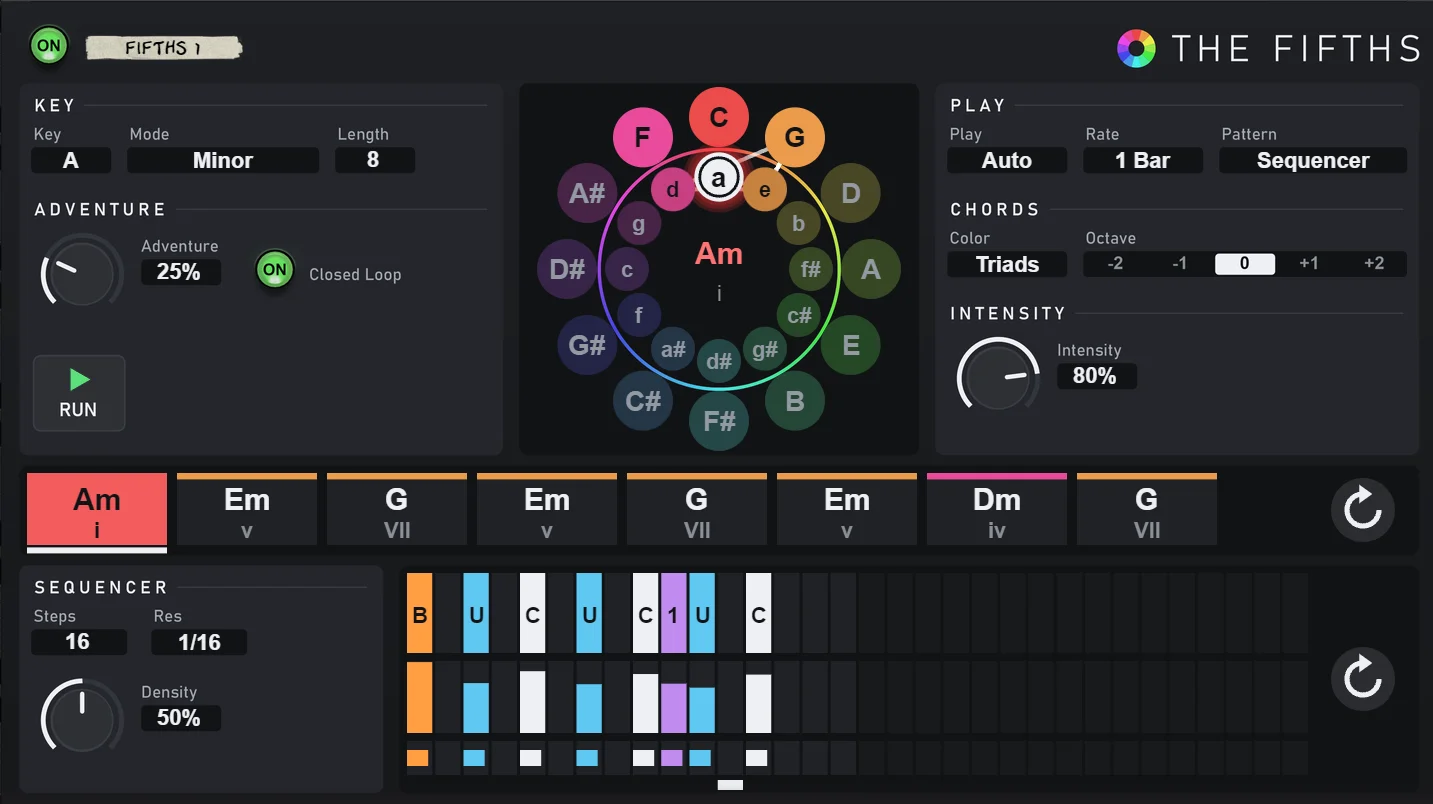
Harmony at your fingertips. Place The Fifths above an instrument, choose a key and one of six modes, and it invents a progression of two to eight chords. Every chord is voiced automatically so that it moves as little as possible from the previous one: the sequence sounds connected from the first click.
From safe to daring. The Adventure knob sets how bold the generator gets: chords of the key only, then secondary dominants and borrowed chords, then modulations to neighbouring and distant keys and tritone substitutions. Closed Loop makes the progression start on the tonic and return to it through a cadence, so it loops seamlessly; switch it off for harmony that keeps drifting. Lock the chords you love and regenerate the rest.
See it on the circle. The circle of fifths in the middle of the panel shows the key, the chords that belong to it, the chord that is playing and the path of your progression. Every key has its own colour, so a progression that stays close to home keeps to a few neighbouring colours while an adventurous one lights up the whole wheel. Click a chord on the circle to drop it into the selected step: you can write a whole progression in a few clicks.
Rich chords, your way. Play triads, sevenths or ninths taken from the key, globally or step by step — a ninth on the dominant only, for instance — and move everything up or down by up to two octaves.
Played for you. Press Run, or start the song, and The Fifths plays at once: it follows Reason’s transport, changes chords every beat, two beats, bar or two bars, and plays them with its step sequencer or one of six patterns: held, quarters, offbeats, bass and chord, oompah or rising arpeggio. Start the song anywhere, jump or loop: the chord that should be sounding is there at once. Run plays it without starting the song. Rather play it yourself? In Trigger mode, every note you play fires the next chord.
Your own rhythm. The built-in step sequencer gives you up to 32 steps, from quarter notes to 32nd notes, triplets included. For each step, choose what plays — the chord, the bass, the upper voices or a single note — how hard and how long, and tie steps together to hold a chord. A Density knob generates rhythms that favour the strong beats, any of the six patterns can be loaded into the grid as a starting point, and locked steps stay put.
Real MIDI notes. Everything The Fifths plays is ordinary MIDI: record it onto a track with Direct Record or Send To Track and edit it by hand. Key, mode, length, play mode, chord rate, pattern, chord colour, intensity, octave and the sequencer settings can be automated along the song, and every knob, button and selector can be assigned to a control surface.
Features
- Chord progressions of 2 to 8 chords, generated in any key and in six modes: Major, Minor, Dorian, Phrygian, Lydian, Mixolydian
- Adventure knob: diatonic chords, secondary dominants and borrowed chords, modulations and tritone substitutions
- Closed Loop for progressions that cadence back to the tonic and loop seamlessly
- Padlock on any chord to keep it when regenerating
- Interactive circle of fifths: shows the key, the playing chord and the path of the progression; click a chord to write it into the selected step
- A colour for every key, shared by the circle and the chord row
- Triads, sevenths or ninths, globally or per chord; automatic voice leading; octave −2 to +2
- Auto mode locked to Reason’s transport, and Trigger mode (each played note fires the next chord)
- Chord rate of 1 beat, 2 beats, 1 bar or 2 bars; six rhythm patterns
- 32-step rhythm sequencer: resolution 1/4 to 1/32 with triplets, per-step note choice, velocity, length and ties, rhythm generator with density and locks, patterns loadable into the grid
- Run button to play without starting the song; playback picks up mid-chord after a jump or a loop
- Real MIDI output: Direct Record and Send To Track
- Automation of every setting that changes the sound; Remote control of every knob, button and selector
- Everything saved with the song
Requirements
- Reason 14
- The Fifths is a Player: it plays an instrument placed below it in the rack.