Sixteen bands, eleven shapes. Every band offers Bell, Low/High Cut, Low/High Shelf, Notch, Band Pass, Band Stop, Tilt, Comb and a key-aware Scale EQ. Cuts run from 6 to 96 dB/oct, shelves have an adjustable slope, and gain reaches ±30 dB. Scale EQ boosts the notes of a chosen key or cuts the notes outside it, across 12 scales and modes on any root. Each band can sit in Stereo, Left, Right, Mid or Side, so you can tighten the low end of the sides or add air without touching the center. Click Isolate to solo any band while you search.
Dynamics on every bell and shelf. Any bell or shelf becomes a dynamic band with Range (±18 dB, cut or boost), Threshold, Attack, Release and Knee. A BP/LP/HP detector filter can follow the band or listen somewhere else, for example cutting 250 Hz when 80 Hz gets loud. Three detection modes (Absolute, Band and Relative) decide how the threshold is judged, so a band can react to bursts rather than to a part that is simply loud. Each band chooses its own trigger: the main input, the external sidechain, or another track through Analysis In. The graph shows each dynamic band’s full range as a shaded area, and a live violet curve shows what the dynamics are doing right now.
Spectral precision when you need it. Switch on SPEC and every dynamic band works per FFT bin instead of as one moving filter, reacting only where the energy actually is. It suits narrow, moving resonances, harsh spots and sibilance. Choose 512, 1024 or 2048 resolution, and set smoothing and global attack/release scaling. Add 0–20 ms lookahead so fast transients are caught from their first cycle. Reason compensates for the latency automatically.
Mix tools that work between tracks. Connect one TV Spektrum EQ’s Analysis Send to another’s Analysis In and the collision overlay shows in red where both tracks fight for the same frequencies. One click on Create Ducking Band adds a dynamic band that ducks only where, and only when, they clash, such as bass under the kick. The red fades as your EQ clears the overlap. Draw mode lets you sketch the curve you want, builds the bands to match, and lets you preview them before you keep them.
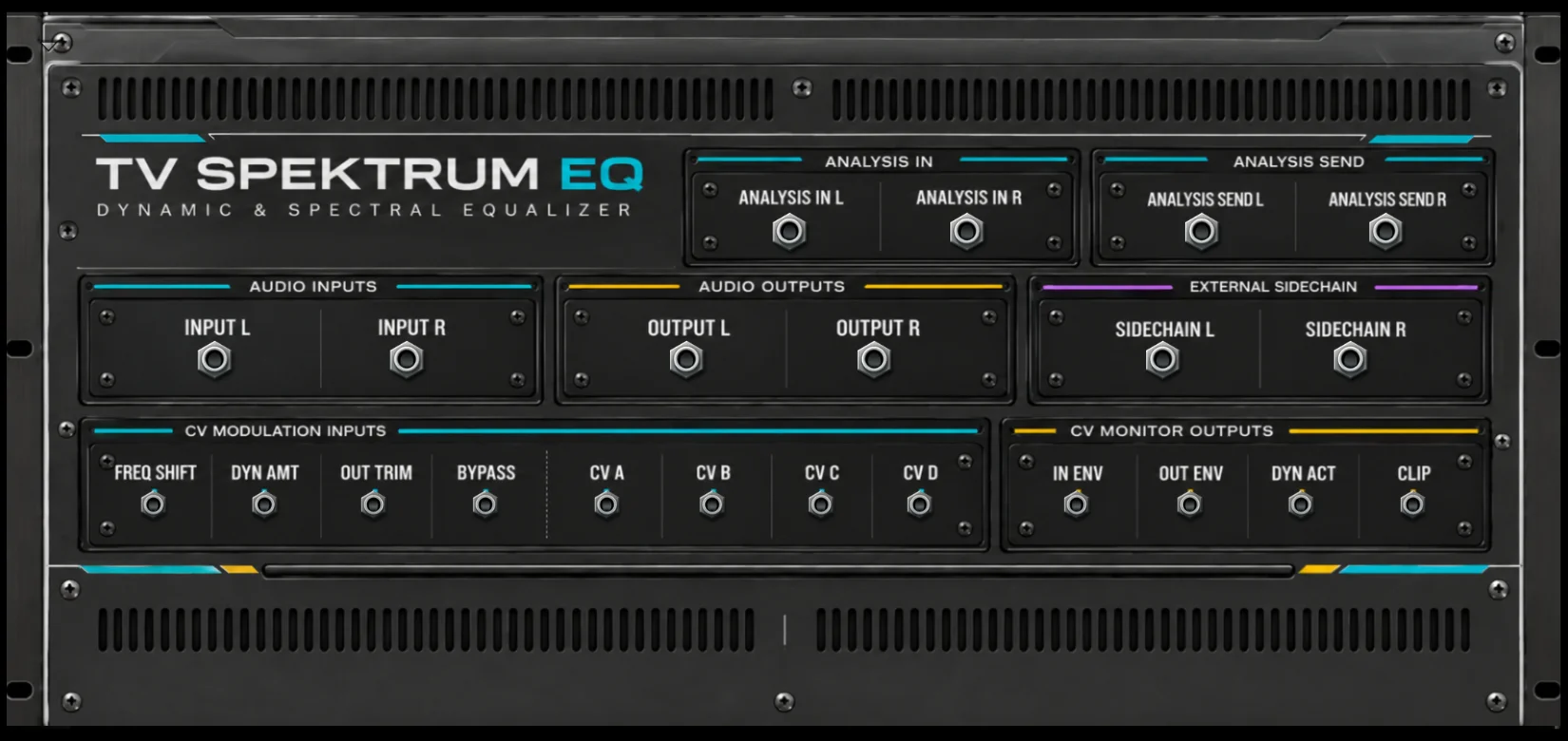
Movement and control. Four modulators (LFO, triggered envelope and envelope follower), each with four routes, can move frequency, gain, Q, threshold, range, tilt angle, comb density, attack, release, output and spectral smoothing. Synced LFOs lock to the song position for rhythmic EQ. On the back panel, 8 CV inputs cover frequency shift, dynamic amount, output trim, a bypass gate and four assignable lanes. 4 CV outputs send the input and output envelopes, live dynamic activity and a clip gate to the rest of your rack.
Built for honest decisions. Compare two complete setups with A/B and Copy. Press MATCH to level the output to the input so you judge the EQ, not a volume change. EQ Amount scales every bell and shelf from 0 to 200% at once, and Mono and polarity invert are one click away. A live input/output analyzer with high-resolution low-end detail, a spectrum freeze and a peak/RMS meter show exactly what changed. 50 factory patches cover drums, bass, guitars, vocals, keys, the mix bus and creative moving sounds.
For Support Email: shanetvmusic@gmail.com