

BitSynthzr
Bit Reduction Synth
- • Unique glitch/lo-fi sound generators
- • Deep, flexible modulation routing
- • Built-in sequencer & audio/CV processor
Audio examples
BITSYNTHZR is a synth built for texture, instability and glitch.
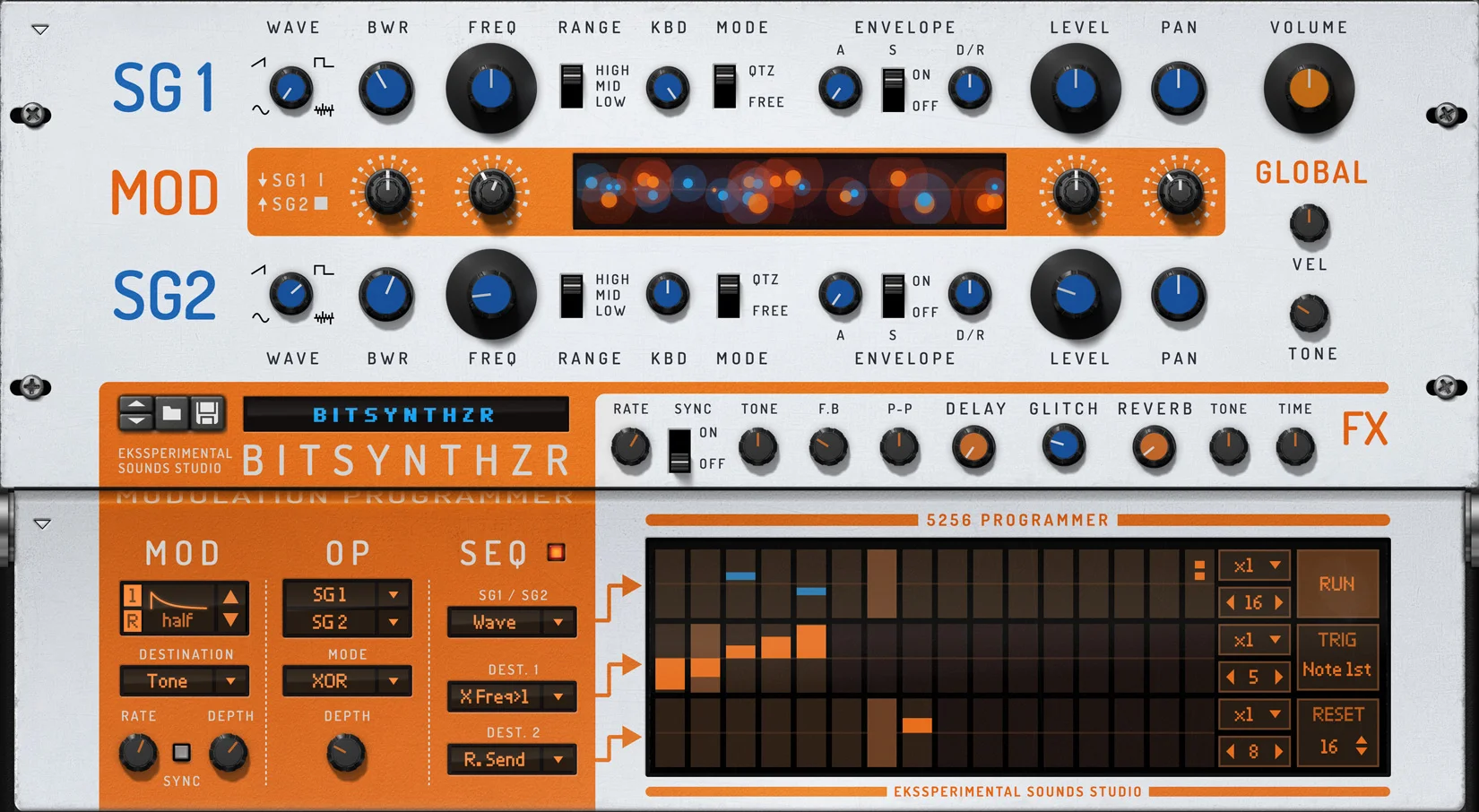
At its core are two Sound Generators, each offering sine, ramp, pulse and a pinging noise with variable bit depth, and each able to modulate the other. Their signals meet in the OP section, a combiner that goes far beyond ring modulation: bitwise XOR, AND, OR and bit-shift, 8-bit wrap-around multiply, MIN/MAX, difference, gating, envelope following and sample & hold. Thirteen ways to fuse two signals into buzzing, unpredictable hybrids, in the spirit of the name. A 3-lane sequencer with its own CV outputs, an LFO-driven modulation section and a built-in glitch engine let a patch twitch, stutter and mutate on its own, while onboard Delay and Reverb smear it into something more spacious.
BITSYNTHZR is quirky by design. There is no traditional synth filter, only a master Tone control, so the sound is shaped by bits, pulse widths, cross modulation and logic rather than by a cutoff knob. The sequencer can be clocked by either Sound Generator, all the way up to audio rate, where the pattern stops being a rhythm and becomes the timbre itself. It’s less a preset machine than an experimental playground.
Quality settings go beyond a simple sample-rate switch: dropping to ECO or LOW decimates the voices themselves, baking real lo-fi grit and aliasing into the sound. Route external audio or CV into the Operator and BITSYNTHZR becomes a glitch and logic processor for anything you feed it, with or without notes playing.
Eight voices of beautiful malfunction: crackling leads, fractured basses and pads that come apart just enough to feel alive.
BITSYNTHZR is built on Reason’s Rack Extension SDK 5 and uses its newest panel features. The front panel folds out into the Modulation Programmer, a drawer that holds the LFO, OP and sequencer, so the full depth is one click away without taking up rack space. The cross modulation is controlled with concentric dual knobs: the inner knob sends SG1 to SG2 and the outer ring sends SG2 back to SG1, so all eight modulation paths fit in one row.