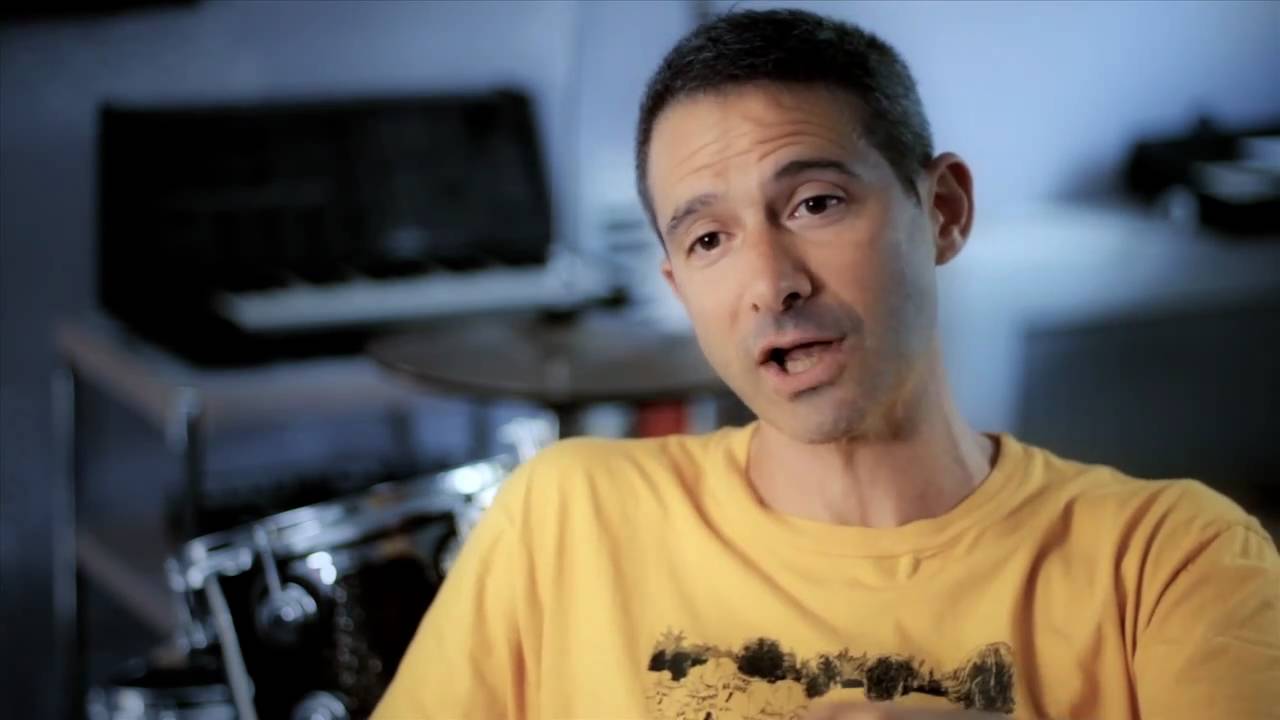
To hear Adam Horovitz describe his first experiences with beat-making you’d almost think it sounds easy. “I didn’t know that was something I could do,” he says almost dismissively. “And I did. And I got into it” But under his moniker “Adrock” and along with the other two Beastie Boys, Mike D and MCA, Adam didn’t just make beats… he helped invent a whole new style of beat collage and layered production that inspired a generation of artists that would follow them. The Beastie Boys have an uncanny ability to convey fun and experimentation – perfectly maintaining the humor from their early jams all the way to the final master. It’s a feat not often duplicated for many who let the perfectionism, quantization, and over-analysis of the recording studio environment ultimately deflate the creative output.
Adam invited us over to his home studio in New York City where he produces all of his ideas. After nearly 15 years producing music on his trusty SP1200 workstation, Adam made a near instant switch to Reason after a recommendation of fellow Beastie Boy, Mike D.
For this interview, there were too many great stories to fit into a single interview so be sure to check out Adrock’s deleted scenes for some gems you’ve probably never heard before.
Transcript
Main Interview
- 00:02 – Intro
- 00:15 – Starting a band and meeting the Beastie Boys
- 00:30 – The hardcore scene turns to rap
- 00:47 – Making “License to Ill” with tape loops
- 01:29 – Getting an SP-1200 from Ice-T
- 01:41 – Why the SP-1200 stuck
- 02:02 – Switching to Reason
- 02:28 – Everything in one box
- 02:47 – Writing with Mike D and Adam
- 02:57 – Starting with the beat, using ReCycle
- 03:44 – Building the beat live
- 04:07 – Adding kicks and snares in Redrum
- 04:15 – The Thor synth
- 04:48 – Working in Reason and Pro Tools today
- 05:19 – Wrap-up
Intro
In good shape. What’s up? Hi everybody. Welcome to the internet.
Starting a band and meeting the Beastie Boys
I started making music in high school. I started my band called The Young and the Useless, and we used to hang around with the Beastie Boys. They needed a guitar player, and since I was there — so, you know, that’s sort of how it all happened for me. And this is like 1982.
The hardcore scene turns to rap
All of us on the hardcore scene, we were really all like — all we were listening to was rap music at that point. We’re going on tour, and we’re like, “well, this is a drag,” like carrying drums and amps and [bleep], so let’s just do rap and just have two turntables and a mixer. It was a matter of convenience and laziness.
Making “License to Ill” with tape loops
Yeah, so when we started making License to Ill, we had tons of tape loops on there. The thing about sampling for me was, you know, you rap over these breaks, and then you had the John Bonham beat, and I’m like, “whoa, let’s do that.” And it’s not like we were the first people to do that — I mean, tons and tons of people were doing that, but we hadn’t realized that, so we discovered it for ourselves, and it was really cool. If you can have the beat going, then you can certainly cut in James Brown horns, or any of that stuff. And so we were just into that, like, layering and layering of [bleep], which was definitely influenced by Public Enemy.
Getting an SP-1200 from Ice-T
I got an SP-1200, which I believe belonged to Ice-T. Thank you, Ice-T, for my first sampler.
Why the SP-1200 stuck
The SP-1200 makes you come up with your own thing, as opposed to just using the thing that somebody else made. It was very hands-on — when you played it, it was like a video game, and you had to chop [bleep] up. And I didn’t use the SP-1200 because it was like an 8-bit, or whatever-bit, machine — I don’t really care about that, it just was what I liked to use. The SP-1200 was the sampler that I used, and that’s the only sampler that I used, until Reason.
Switching to Reason
Mike and my band was like, “Yo, this [bleep] called Reason just came out. My friend Wag has it, I’m buying it, you got to get it.” And so I said, “okay.” I went and bought this stuff called Reason. Never looked back.
Everything in one box
Absolutely. I like the SP-12 because it’s all in this one little box. And then Reason came out, and it was just all this crazy [bleep] in the box. But it was mindboggling how much stuff is in the box.
Writing with Mike D and Adam
Me, Adam, and Mike, we work very similar in that we’ll just make some [bleep] at home, just a basic idea, and bring it in, and it’s sort of a matter of whose idea we like the best.
Starting with the beat, using ReCycle
Normally, what I do is I start making things with a beat — for me, it starts with the beat. I like to use ReCycle because it emulates that thing we’re talking about with the SP-1200 sampler, because then it chops it up nice, and it’s easy to chop it up. On the SP, you had to load it, copy it, but that copy you had to chop just to the little one note, and then you had to delete all the other stuff, and then copy it again, delete — you know, get that other next note, delete all the other stuff. It was like this whole process, and so it was just hours. And this takes 30 seconds — you just open it up, boom, sensitivity, bah-boom, then you got your beat.
Building the beat live
And then, what tempo are we on? 101. Whoa, I know. And so, at any rate, this is what I do when I’m making music — I just kind of [bleep] around with beats, and then usually just pause for a while and say, “wow, aren’t computers cool?” So then, you got your little beat, and to fill it out…
Adding kicks and snares in Redrum
Then I use the Redrum — then you add your kicks and snares. So you see, I just do it all in here. You can do your little bass sounds, okay.
The Thor synth
So the other one is this Thor thing — like, Thor is crazy. I mean, that’s the thing about Reason, is it just doesn’t stop. It really doesn’t stop.
Working in Reason and Pro Tools today
Sorry. Basically, I do all my music in Reason and Pro Tools. And now that this, you know, Record thing is out, like, it seems like I should just do everything in Record. I just really like the way Reason works, and so I think that’s probably what I’m going to end up doing. I just like that it’s all in this one little thing — my SP is collecting dust right now.
Wrap-up
So that’s what I got. Well, the other thing is that I kind of discovered LL Cool J — I mean, that’s a whole other, you know, I didn’t want to say that or get into that story, but since we’re on the subject…
Deleted Scenes
- 00:00 – Buying an 808 instead of a guitar
- 01:20 – Discovering LL Cool J via a demo tape
- 02:01 – A punk band that loved rap
- 02:53 – Pause tapes: the original sampling technique
- 03:55 – Writing “Fight for Your Right (To Party)” as a joke
- 04:42 – The song blowing up faster than expected
- 05:12 – Pranking a German crowd with the “Rocky” theme
- 05:44 – Discovering tape loops at MCA’s apartment
- 06:51 – The first sampling lawsuit
- 07:42 – When “loops” became “samples”
- 08:17 – The Power Tools show and meeting Mario Caldato
- 09:16 – Learning engineering from Mario Caldato
Buying an 808 instead of a guitar
All right, so here’s a little history. I got some money in high school — I got $250 — and I went to Rogue Music on 30th Street. I wanted to go and buy a black-and-white Rickenbacker, like Paul Weller of The Jam, and I was looking at that Rickenbacker, and I was like, “[bleep], I got 250 bucks, I’m ready to go.” And I saw an 808, the Roland TR-808, and I was like — asked the guy at the place, “how much is that?” “It’s 250 bucks.” And so I was like, “do I buy the Rickenbacker? I already have a guitar, but it’s not the cool Paul Weller guitar. Or do I get the drum machine?” I kind of wanted a drum machine — I’d never had one, everybody’s talking about drum machines, so I should get this one. And so I got it — you can do a little insert of that 808 right there. So I bought the 808 instead of the guitar, I just plugged that in, you know, my little [bleep] Emerson speakers, and it sounded awesome. I was like, “this is what I want to do,” and that’s how I got into it. And I just, you know, wanted to make — I just got into it, I don’t — I didn’t know that was something I knew how to do, and I did, and I got into it, and I made the beat for LL Cool J’s first record.
Discovering LL Cool J via a demo tape
I’ve heard that. That’s right, you’re welcome. Well, the other thing is that I kind of discovered LL Cool J — I mean, that’s a whole other, you know, I didn’t want to say that or get into that story, but since we’re on the subject: I used to be at Rick’s place all the time, and he had just started Def Jam Records, and he had one 12-inch out, by T La Rock and Jazzy Jay. And then people started sending him demo tapes, and I was the one that listened to the demo tapes. So if you sent a demo tape back in 1984 and didn’t get signed, I apologize. But I got one, around ’85, from a kid who called himself LL Cool J, and I said, “man, this is really good, Rick, you got to check it out.”
A punk band that loved rap
In the early ’80s, and, you know, around that time — late ’70s, early ’80s — when rap was getting played on the radio, I mean, we’re, you know, in New York City, downtown New York, you heard “Rapper’s Delight,” and you heard rap music on the radio in New York. And so all of us on the hardcore scene, we all loved rap music too, and it was just starting to spread throughout New York. We were a punk band, and we were really all like — all we were listening to was rap music at that point. So we’re like, “okay, should we — you know, make what we love?” And so we were playing our shows, we would play like half punk and then half rap. You know, the shows we played were just for our friends anyway, so it wasn’t like there was some weird thing happening — it was like, “oh yeah, you know, Adam and Mike love rap music, and we do too.” And so it’s like, you know, we were all changing it — it wasn’t just the three of us, it was our whole group of friends.
Pause tapes: the original sampling technique
Hank was telling me about pause tapes — did you guys ever do that? Oh man, I got pause tapes, I was a pause-tape battler, I mean — oh yeah, pause tapes is basically, you know, you had a double-cassette deck, and that was basically the most advanced equipment that you had, or at least that I had, that I could afford. And so it was the double tape deck, and you basically made loops by, you know, the drum beat comes in and you record from the left side, the play side, to the record side. And so you’d have to just get the pause button just right, so when the beat came up you’d unpause it, the beat would go, and then you’d have to pause it just perfectly before the [other] music started. Then you rewind, and you do it again, you do it again, so you just have your little loops going on the cassette tape.
That’s some caveman [bleep]. That’s what we used to work with — you know, banging stones together to make a fire. And that’s the other thing, is you smoke a lot of weed and you make pause tapes, and then you try to play it for somebody, and people are like, “why am I listening to this, who cares?”
Writing “Fight for Your Right (To Party)” as a joke
All right, so basically, yeah, and our friend Tom wrote the song “Fight for Your Right (To Party).” They had a band called Brooklyn, and they’re like, “what’s the stupidest thing we can come up with? We need an anthem, what’s the stupidest thing we can come up with?” So they were like, “you got to fight for your right to party.” And so it was like this thing, we’re like making fun of frat-jock dudes or whatever, and we’re like, “you got to fight for your right to party.” And then we started playing shows, and we’re like, you know, drink tickets, free drinks, and then more people are listening to us, so we’re getting paid more money, and we’re going to places, and you know, just like one of those things that becomes what you hate in theory sometimes. And then, you know, you’re just all lit up, and you’re like, “yeah man, you got to fight for your right to party.” And then, you know, that got kind of tired, kind of fast.
The song blowing up faster than expected
And so we’re like — and we did blow up kind of fast, big, you know, in ’86, ’87. A lot of 1987 was kind of an “oh [bleep]” moment, like — where you’re like, you have this joke song, you’re like, “fight for your right to party,” everybody honestly says, “yeah, yeah dude, we got to fight for our right to party.” I’m kind of like, “yeah, that’s right, we do.” Wait a minute — whoa, it’s all kind of happening too fast.
Pranking a German crowd with the “Rocky” theme
And then I remember we went and toured our first tour in Europe, and we went to Germany, and we’re like, “what’s the funniest thing that we could do to piss off the Europeans?” And we played the Rocky theme, and we came out with boxers’ robes — it was like we came out, like, “USA” on our backs, we’re like, “what’s up!” And it was all American Army dudes stationed there, the crowd went [bleep] nuts, and we’re like, “well, you know, the thing of like making this, that, and the other is not that funny — let’s just make what you have to make, do what you do, no reason to go outside of your realm, just make what makes you happy.”
Discovering tape loops at MCA’s apartment
Okay, so sampling — I remember we went, I went to MCA’s apartment in Brooklyn, and this has got to be ’84, maybe around ’84, ’85, around then. And he was like, “oh [bleep], you got to see this thing that I did,” and I went into his place, and he had just a tape — just a tape loop running all the way around his apartment, and it was the John Bonham beat, you know, the — what is that, “When the Levee Breaks” or something — “When the Levee Breaks,” and he’s got it, like, you know, the tape deck, and he’s got a piece of tape going all the way around, it’s getting held up by like a mic stand, a chair, and it’s just going around, you know, that beat. And I’d never — who knew you could do that? I didn’t know. He’s like, “yeah, yeah, tape loops, you know, Jimi Hendrix used to do it, and Sly Stone used to do it.” And I was like, “oh [bleep], that’s [bleep] cool — if you could have the drum beat going, then why not have some horn playing, or any of those breaks, or any of those grooves, or whatever, why not, you know, rap on those, like you were just doing” — you know, a couple of years ago.
The first sampling lawsuit
I believe that the Beastie Boys’ was the first legal document to use the word “sample” in terms of a music-license infringement — I don’t know how much I’m allowed to talk about that, but yeah, a lawsuit, the Jimmy Castor Bunch, “Hey Leroy” — we used their record, and they sued us, which I’m sure — someone played them like, “that’s our record on their record, how does that make sense?” And so, you know, they were like, “you should pay us,” which makes sense, and we used plenty of it. And so they were like, “you know, this is a sample of music,” and blah blah blah — so that’s what I believe, or I’ve been told, was the first sample lawsuit.
When “loops” became “samples”
You didn’t really call it sampling — what did you call it? You know, “the [bleep] up beat,” I don’t know, you just called it whatever it was, loops. Okay, but then when you would do something that wasn’t necessarily a loop, but it would just be an action, we didn’t call it samples — until, you know, it all kind of caught on, until, like, Paul’s Boutique, you know — they just had some crazy machine that you could, that played this music, like it was a computer thing, and I was like, “that’s [bleep] crazy, I don’t even know what that is, I’m just going to bring my records and you guys do it.” And for the record, I’m fine if somebody wants to take something that I’ve made and chop it up, and it’s like their own new thing — that’s interesting to me.
The Power Tools show and meeting Mario Caldato
We played a show in L.A. at this club called Power Tools, and this is a little bit of history — we played the show at our friend Matt’s club, Power Tools. We come on, the 808 goes boom, blows the whole PA up. This guy, Mario Caldato, goes up to our friend Matt and says, “I told you, man, I met you a couple weeks ago and said you should let me do sound, I’m going to do sound from now on at your club.” Mario and Matt met these other guys, they started the Dust Brothers, of Paul’s Boutique fame, and a lot of other things. And then Mario Caldato — when we went back to L.A., we met Mario, we needed an engineer, and through him we met, you know, all these people.
Learning engineering from Mario Caldato
Mario was our engineer. Mario was the guy that knew all of the stuff — Adam, MCA, and Mario knew, you know, they know all of the gear and techniques. And that’s what Mario, you know, while we were being a band growing up, Mario was being an engineer growing up, and that’s what he was into — studying how Jimmy Page got his sounds, how Lee Perry got his sounds, like all the great producers and engineers and stuff. And so I was really lucky to get to work with Mario, because he taught me a lot, in terms of how to, you know, engineer. And when we started recording, Mario, for years we worked together, he recorded everything — I mean, we have hundreds of hours of tapes of just really bad, like, jamming.