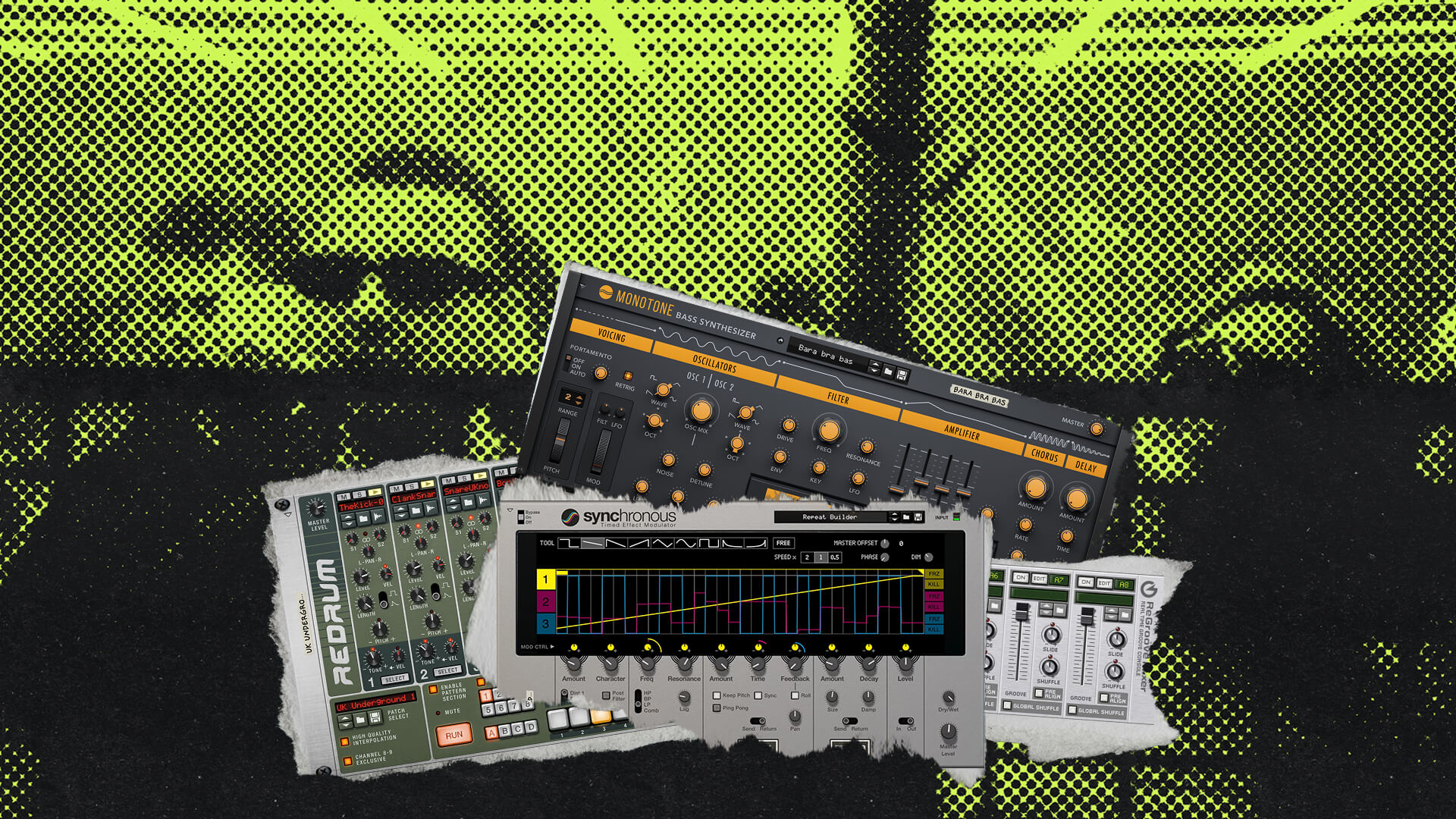
UK garage is one of those genres that shaped electronic music for decades, and now it’s back. If you’ve heard PinkPantheress and wondered what gives her tracks that skippy, nostalgic feel, you’re hearing UK garage’s influence. In this guide, you’ll learn what the genre is, where it came from, and how to build your own UKG tracks, step by step in Reason 14.
Whether you’re brand new to the genre or looking to add some swung UK flavor to your productions, we’ll walk through everything from the signature drum patterns to layering synths for a proper drop. Let’s get into it.
What is UK garage?
UK garage (often shortened to UKG) is an electronic dance music genre that emerged in the UK in the early-to-mid 1990s. It blends shuffled, swung rhythms with deep sub-bass and chopped vocal samples, creating a sound that feels both energetic and soulful.
Garage traces its name to New York’s Paradise Garage, whose influential resident DJ Larry Levan became closely associated with the soulful dance sound that helped inspire garage house. When that sound crossed the Atlantic, UK producers put their own spin on it.
They drew from US garage house (especially its chopped-vocal style) and jungle (for bass weight and breakbeat energy). R&B gave the genre its melodic hooks and vocal textures.
UK garage grew up on UK pirate radio stations and in underground clubs. It was rooted in Black British culture and the multicultural communities of the city. By the late 1990s, tracks like “RIP Groove” by Double 99 and “Sweet Like Chocolate” by Shanks & Bigfoot had pushed UKG into the mainstream.
The sound of UK garage
What makes UKG instantly recognizable? A few key elements come together: tempo, rhythm, bass, and vocals. Once you understand these building blocks, you’ll start hearing them everywhere.
Tempo and rhythm
UKG typically around 128–135 BPM, with variations depending on style and era. What really defines it is the swung, shuffled feel. The drums don’t land rigidly on the grid. They bounce.
You’ll hear two main drum patterns in the genre. The first is four-on-the-floor, where the kick hits on every beat (1, 2, 3, 4). The second is 2-step garage, which became the mainstream sound by the late 1990s. In 2-step garage, the kick pattern is “broken,” meaning it doesn’t hit on every beat. This creates that skippy, syncopated groove you hear in tracks by MJ Cole and Artful Dodger.
Bass and vocals
Sub-bass is essential. UKG tracks lean heavily on deep, rolling bass that you feel in your chest. The bass often follows simple melodic patterns, locking in with the kick to drive the groove forward.
Vocals are distinctive too. Producers chop them up and reshape them with time-stretching or pitch-shifting. You’ll hear soulful R&B vocals sliced into stuttering fragments or stretched until they take on an almost underwater quality. This technique became a signature of the genre and still sounds fresh today.
Subgenres and what it influenced
The genre branched into different styles. Speed garage came earlier and hit harder. It kept the four-on-the-floor kick while adding jungle-influenced basslines and a more aggressive edge. 2-step garage (often shortened to “2-step”) took over in the late 1990s, bringing that broken kick pattern and a smoother, more radio-friendly sound.
The genre’s influence didn’t stop there. Grime, dubstep, UK funky, and bassline are all widely credited as descendants of UKG. Dubstep producers built on UKG’s syncopation and bass-heavy production while creating a sparser, often half-time-feeling groove around 140 BPM. When grime MCs started spitting over dark, minimal beats, those productions owed a debt to UKG techniques.
Why UK garage is back
The genre never fully went away, but it’s enjoying a genuine revival right now. In the 2010s, artists like Disclosure, Jamie xx, and returning veterans like Craig David and MJ Cole brought UKG elements back into popular music.
The 2020s have pushed things further. PinkPantheress draws heavily on UKG and 2-step in her production style. Her 2021 track “Pain” samples “Flowers” by Sweet Female Attitude, a classic UKG tune from 2000. Other artists like Eliza Rose, Interplanetary Criminal, and Sammy Virji are keeping the sound alive and introducing it to new listeners.
If you’re curious about UKG, there’s never been a better time to explore it. The genre’s influence is everywhere in current pop and electronic music.
Before you start: what you need
Before jumping into the tutorial, make sure you have these things ready:
- This tutorial uses Reason 14, with its modular Rack, samplers, and built-in sounds.
- Have a drum break or loop ready to chop. UKG often pulls from house and jungle drum traditions.
- Have a melodic idea to interpolate (replay a melody using your own sounds).
- Keep a reference track handy so you can check your groove against the real thing.
Reason 14’s automatic tempo detection and looped clips help you work faster. When you drag in a loop, Reason matches it to your project tempo. Looped clips let you drag to duplicate sections without copy-pasting.
How to make UK garage in Reason
Now for the fun part. This step-by-step tutorial is based on producer J-Lang (Noah) building a PinkPantheress-style beat in Reason 14. We’ll walk through each stage, from interpolating a melody to arranging the final track.
1. Write a simple guitar melody
Start by creating a short melodic idea of your own. Keep it simple: a few notes with a clear rhythm will often work better than an overly busy phrase, especially once the drums and bass come in.
Load an NN19 sampler in the Rack. NN19 is Reason’s digital sampler, great for playing patches chromatically. Browse the patches and find an acoustic guitar sound you like.
Then play in a short guitar melody, leaving some space between notes so the rhythm can breathe. Try repeating a small motif and changing the last few notes every couple of bars. This gives you a memorable melodic hook while leaving plenty of room for the rest of the beat.
2. Build the pad chords
Next, grab a Polytone synth from the Rack. Polytone is a polyphonic synthesizer with a warm, lush sound.
Duplicate the guitar melody clip you just recorded. Now reshape those notes into pad chords. Where your guitar line plays single notes, stack them into chords that fit the harmony.
Browse Polytone’s patches until you find one that complements the guitar without overpowering it.
3. Set tempo and pitch
Here’s a trick for making your parts feel more original: pitch both the guitar and the pad down a couple of semitones. This moves the whole thing into a slightly different harmonic space.
Then push the tempo up. For this beat, go to around 155 BPM. That’s faster than classic 130 BPM UK garage, leaning more toward a garage/jungle hybrid feel. Experiment until the energy feels right.
4. Chop a jungle-style drum break
Drums in this style often borrow from house and jungle. Jungle in particular is known for chopping up drum breaks and playing them back fast.
Load a Dr. Octo Rex loop player. This device lets you slice loops into individual hits and rearrange them however you want. Browse the drum loops until you find a break that sounds good, then draw in your own chop pattern. Move the slices around and repeat certain hits until you have a rhythm that bounces.
To add grit, use Scream 4 or another included distortion effect. If you have Reason+ or own the Osmium add-on, Osmium is an especially good option for targeting specific frequency bands for saturation. Dial in just enough to give the break some weight.
5. Layer your kick and percussion
Your chopped break might not have enough low end on its own. Cut some of the low frequencies from the break using EQ, then layer in your own kick underneath for weight.
Add a shaker or tambourine on top to fill out the high end. When you drag in a loop at a different tempo (say, a tambourine recorded at 120 BPM), Reason 14 automatically matches it to your project’s 155 BPM. Use looped clips to drag and duplicate the percussion across your arrangement.
6. Add the bassline
Load a Monotone bass synth. Monotone is a monophonic synth designed for punchy bass sounds.
Browse the patches and pick one with a solid sub presence. Now record a bassline that locks in with your kicks.
In this genre, the bass and kick work together closely. Where the kick hits, the bass often hits too. Keep the pattern simple at first, then add variation once the groove feels locked.
7. Layer synths for the drop
UKG and pop-garage tracks often start sparse and get bigger at the drop. The way to achieve that “bigger” sound is layering.
Under your guitar line, add two synth patches playing the same notes. For example, try an NN19 strings patch for a smooth, sustained layer and a Thor pad EQ’d to sit in the mids so it doesn’t compete with the bass. You could also add a Europa patch dropped an octave for warmth, but start with two layers and see how it feels.
Do the same under your pad chords. Keep the layers subtle. You’re adding fullness, not replacing the original sounds.
8. Arrange the track
Now pull everything together into an arrangement. Here’s a simple structure that works well:
Start with a sparse first 8 bars. Just the guitar and one other element (maybe a light vocal chop or a single drum loop). Let the listener settle in.
Then bring in the pad chords and build the arrangement with extra drums and layers.
Around bar 16 or 24, hit the drop. This is where everything comes in: full drums, bassline, all your synth layers. Let it ride for about 24 bars.
End sparse, like you started. Bring the energy back down so the track feels complete.
9. Add risers and sound FX
Risers help build anticipation before the drop. Automate a modwheel noise riser so it swells up right before everything hits.
Sprinkle in a couple of ear-catching sound effects. Maybe a delayed synth patch that echoes in the background. Or an unusual sound (like an owl-like effect from the NNXT sampler) that adds character without distracting from the groove.
10. Add a counter melody
Finally, bring in a synth lead for a short counter-melody. Load a Layers device (or, if you don’t have Reason+ or own Layers, another synth) and play a simple melodic flourish over part of the drop. This adds interest and helps the track feel more alive.
Once your track is arranged, test it with an acapella vocal. Drop in a vocal sample and see if the feel of your track sits in that garage/pop-garage pocket. If the vocal bounces and feels natural over the track, you’re in the right place.
Common mistakes to avoid when making UK garage
When you’re starting out, watch for these pitfalls:
- Forcing a rigid four-on-the-floor when 2-step’s swing is the point. That broken kick is what gives 2-step its bounce.
- Ignoring sub-bass. UKG needs that low-end weight. Turn it up or pick a punchier patch.
- Over-layering so the intro isn’t sparse. The contrast between sparse and full is what makes the drop hit.
- Not matching tempos when chopping breaks. If your break is at a different tempo and you skip time-stretching, things drift.
Conclusion
UK garage is a swung, bass-driven UK sound built from chopped breaks, rolling basslines, and layered synths. Its skippy rhythms and soulful vocal chops have shaped electronic music for decades, from grime and dubstep to today’s pop charts.
The steps above give you a foundation: interpolate a melody, build pad chords, chop a jungle break, layer your synths for the drop, and arrange from sparse to full and back again. But the real fun is in experimenting. Try different breaks and stack unexpected synths. Experiment with the tempo. UK garage has always been about producers putting their own spin on things. Now it’s your turn.
Ready to make your own UK garage tracks?
FAQ
Why is it called UK garage?
The name comes from New York’s Paradise Garage nightclub, where garage house originated in the 1980s. When that sound traveled to the UK, producers developed their own version, and the “UK” was added to distinguish it from its American roots.
What BPM is UK garage?
UKG typically sits around 130 BPM, though the broader genre family spans roughly 130 to 140 BPM depending on the subgenre and era.
Did dubstep come from UK garage?
Yes. Dubstep and grime are widely credited as descendants of UKG, building on its production techniques while slowing tempos and pushing basslines deeper.
Is UK garage still popular today?
UKG is enjoying a strong 2020s revival. Artists like PinkPantheress, Eliza Rose, Interplanetary Criminal, and Sammy Virji draw on the sound, and its influence can be heard across current pop and electronic music.
What do you need to make UK garage?
You need a DAW like Reason, a drum break to chop, a bassline that locks in with your kick, and layered synths to build from sparse intros to full drops.