Reason Free opens up a surprisingly deep ecosystem of Rack Extensions without requiring you to spend anything, except the time it takes to explore them! While there are plenty of freebies in the shop, the best ones are not just novelties. They can genuinely solve mixing problems, expand Reason’s modulation possibilities, generate distinctive sounds, and cover jobs that would otherwise require paid devices.
These ten free Rack Extensions stand out because they each bring something useful to the production process, whether that means surgical dynamics control, unusual synthesis, stereo manipulation, rhythmic movement, or better visual feedback while mixing.
1. Omega DEQ by Forgotten Clank Studios

Omega DEQ is one of the most immediately useful free Rack Extensions for mixing. It combines parametric EQ with dynamic processing, letting you cut or boost frequencies only when the signal actually calls for it. That makes it useful for taming harsh resonances, reducing mud, de-essing vocals, or controlling troublesome frequencies without permanently carving them out of the sound.
Its real strength is flexibility. You can blend static and dynamic EQ behavior, use lookahead, feed it from a sidechain, and work in different stereo modes, including independent left and right processing. It is the kind of tool that can quietly fix problems across vocals, drums, instruments, buses, and even mastering chains.
The main caveat is that official support ended in January 2025, but as a free dynamic EQ with this level of control, it still offers a lot of practical value inside the rack.
2. wbl5515 by omino.com

wbl5515 is almost the opposite of a conventional utility device. It is a dual drone synthesizer built around a deliberately strange, vintage-hardware concept, with two oscillator sections designed for sustained, unstable, ring-modulated textures.
The A side leans into ring modulation, while the B side offers a somewhat cleaner variation. Both can produce gritty, crackling, uneven tones, and each side has a smoothing filter for bringing some control back into the sound. The result is a device that feels less like a polished modern synth and more like an odd piece of forgotten laboratory equipment.
That character is exactly why it is worth having. For ambient music, drones, sound design, experimental intros, unsettling textures, and layered noise, wbl5515 can generate material that would take considerably more effort to build from conventional oscillators and effects.
3. Little LFO by Little IO
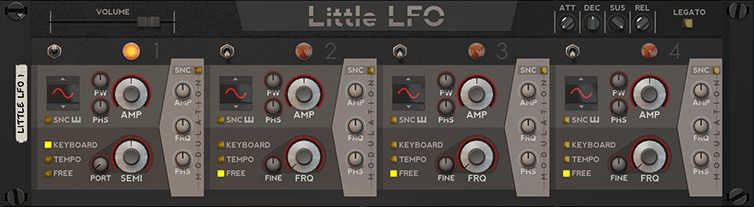
Little LFO is far more capable than its name suggests. At its core, it is a four-oscillator semi-modular device with 15 waveforms, but it can function equally well as a synthesizer, modulation source, rhythmic generator, or CV utility.
Each oscillator has extensive control over frequency, amplitude, phase, pulse width, synchronization, and modulation. The device also provides bipolar and unipolar CV outputs, ADSR CV, gate and note connectivity, and multiple ways of synchronizing oscillators to the keyboard or tempo.
That makes Little LFO particularly valuable in a Reason rack where CV is part of the creative process. You can use it to animate filters, automate movement, build evolving patches, create rhythmic modulation, or generate complete sounds of its own. The included 125 Combinator patches also give you plenty of starting points for synths, basses, drums, and effects.
4. Virt Vereor by Noise Engineering
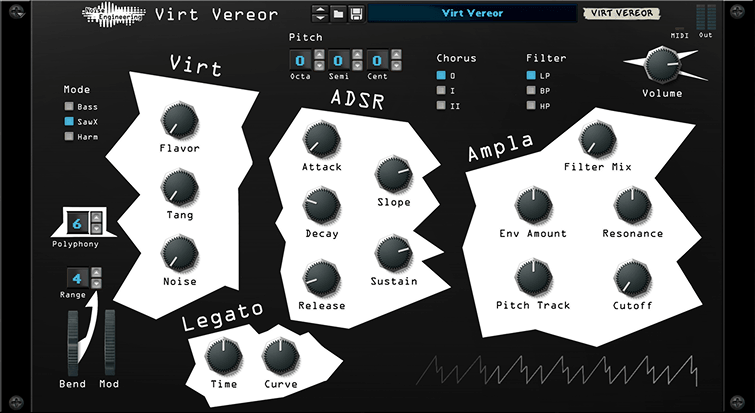
Virt Vereor is one of the strongest free choices if you want an instrument that feels modern, immediate, and capable of getting unusual quickly. It centers on three oscillator algorithms, each aimed at a different kind of synthesis.
Bass uses quadrature synthesis, Saws delivers a supersaw-style sound, and Harm uses additive synthesis with spectral shaping and distortion of partials. Those oscillator modes are paired with an ADSR envelope, VCA, multimode gate and filter section, and chorus, giving you enough architecture to build complete basses, leads, pads, and experimental patches without additional devices.
The simple front panel keeps it approachable, but the back panel opens up deeper CV modulation and self-patching possibilities. With 500 presets included, Virt Vereor works equally well as a fast preset instrument or a compact modular playground for designing your own sounds.
5. Nautilus Bass Synthesizer by Skrock
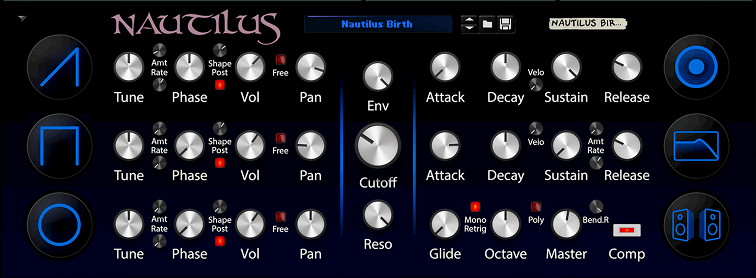
Nautilus is a bass synth with a useful twist: each of its three oscillators has its own waveshaper, and each waveshaper can be positioned before or after the filter independently.
That routing flexibility gives Nautilus more tonal range than a basic subtractive synth. One oscillator can be heavily reshaped before hitting the filter while another can remain cleaner until later in the signal path. Combined with saw, square, and sine oscillators, phase controls, random phase, pitch modulation, panning, and an LP24 filter, it is easy to create basses with very different levels of aggression and movement.
It can operate in mono or with up to eight voices of polyphony, so it is not restricted to bass duties either. Glide, dual ADSR envelopes, velocity response, and a built-in master compressor round out a synth that is especially good for punchy electronic basses and heavily shaped low-end sounds.
6. Mr OverDrive by That Music Company

Mr OverDrive is a distortion processor that goes beyond simply making a signal louder and dirtier. It combines analog-modeled distortion with high-pass and low-pass filtering, stereo widening, flexible routing, and CV control.
That combination makes it useful on a wide range of material. Bass can gain extra aggression, percussion can become more abrasive and present, guitars can be pushed into rougher territory, and synth leads or pads can be widened while being driven at the same time. Two different widening methods give you options depending on whether you are starting with a mono or stereo signal.
It also includes parallel outputs on some modules and allows different effect arrangements, so it can fit into more elaborate Reason routing setups. With more than 280 patches and relatively light CPU demands, it is a solid free choice when a sound needs more weight, width, grit, or character.
7. Spectra Additive ReSynthesizer by Synthetech Sound
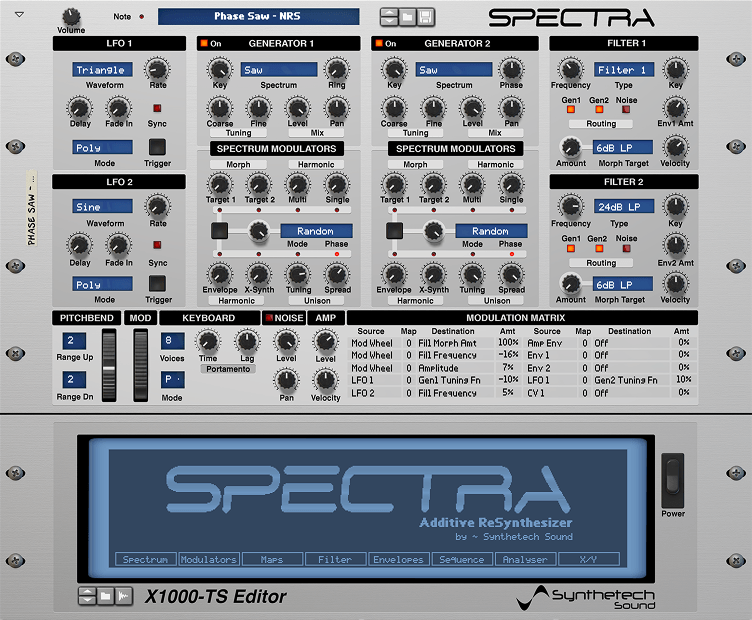
Spectra is easily one of the deepest instruments in this group. It is an additive resynthesizer capable of analyzing periodic harmonic waveforms and rebuilding them as editable spectra, giving you direct control over the harmonic structure of a sound.
Each voice uses two spectral generators, and you can draw harmonic spectra, waveforms, spectral filter responses, and morphing sequences. Spectra can also analyze internal or external sounds and use that information as raw material for new patches.
The modulation system is equally extensive. Two harmonic envelopes contain 256 DADSR envelopes each, allowing detailed contouring of individual harmonics. There are also three 16-stage MSEGs, editable LFOs, XY controllers, external CV inputs, spectral morphing, and filter morphing.
Spectra demands more exploration than the average synth, but for evolving pads, synthetic textures, unusual timbres, and detailed sound design, it offers an extraordinary amount of depth for a free Rack Extension.
8. Pump by sonicbits.io

Pump solves one of the most common production tasks in electronic music: creating rhythmic sidechain-style ducking without having to set up a traditional compressor and trigger signal.
It includes 64 envelope shapes, split between sidechain curves and rhythmic gates. From there, Tension, Slide, and floor level controls let you customize how deeply and how quickly the sound moves. You can create everything from subtle space around a kick drum to exaggerated pumping effects, or invert the behavior and use Pump as a rhythmic gate.
It can sync to Reason’s transport or be triggered by note and gate signals, which makes it useful for patterns that do not follow a basic four-on-the-floor rhythm. The CV output is another major advantage, since the same envelope can control filters, panning, effect sends, or other rack parameters. It is simple, fast, and useful far beyond sidechain ducking.
9. Stereo Converter by Le Note Live Software

Stereo Converter is a focused stereo-widening tool designed around the idea of a mid-side microphone setup. Rather than simply spreading everything outward, it lets you introduce a reflected stereo component while keeping the original signal intact and maintaining mono compatibility.
The Level control determines how much widening is introduced, while Reflected adjusts the timing of the stereo component. A high-pass control applies only to the widened portion of the signal, which is especially useful for keeping bass frequencies centered while allowing the mids and highs to spread outward.
There is also a dedicated mono switch for quickly checking compatibility, plus Send and Return connections that allow other effects to be inserted specifically into the stereo component. It is especially useful when a mono or narrow sound needs more dimension without sacrificing a stable center image.
10. RPSpec Effect by Rob Papen
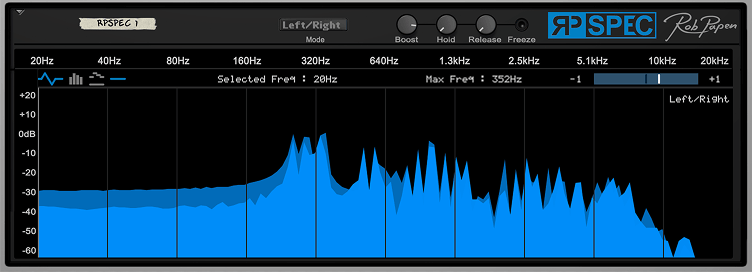
RP-Spec does not make your track sound different, but it can help you make better decisions about everything else that does. It is a dedicated spectrum-analysis device that gives you several ways to visualize the frequency content of your audio.
You can switch between an FFT spectrogram, a 30-band bar display, and a 30-band single-line view, while monitoring the left channel, right channel, or both together. Freeze lets you capture a moment for closer inspection, while Hold and Release controls determine how spectral peaks behave visually over time.
There is also a display-only Boost function that makes quieter material easier to analyze without changing the actual audio level. For identifying frequency buildup, comparing channels, checking tonal balance, or simply learning what different sounds look like across the spectrum, RP-Spec is a useful tool to keep permanently available in your Reason rack.
Final thoughts
Reason Free already gives you plenty of room to build out your rack, and these free Extensions can take things to another level. Still, they only scratch the surface. Paid Rack Extensions work in the free Reason Rack too, so you can keep expanding your setup without upgrading if you prefer.
But if you end up falling in love with Reason and the Rack (like most people who try them out), a full Reason license is the best way to open up the much larger core collection of instruments, effects, and other creative devices not included with Reason Free. The choice is yours, but either way, have fun exploring and making great stuff!