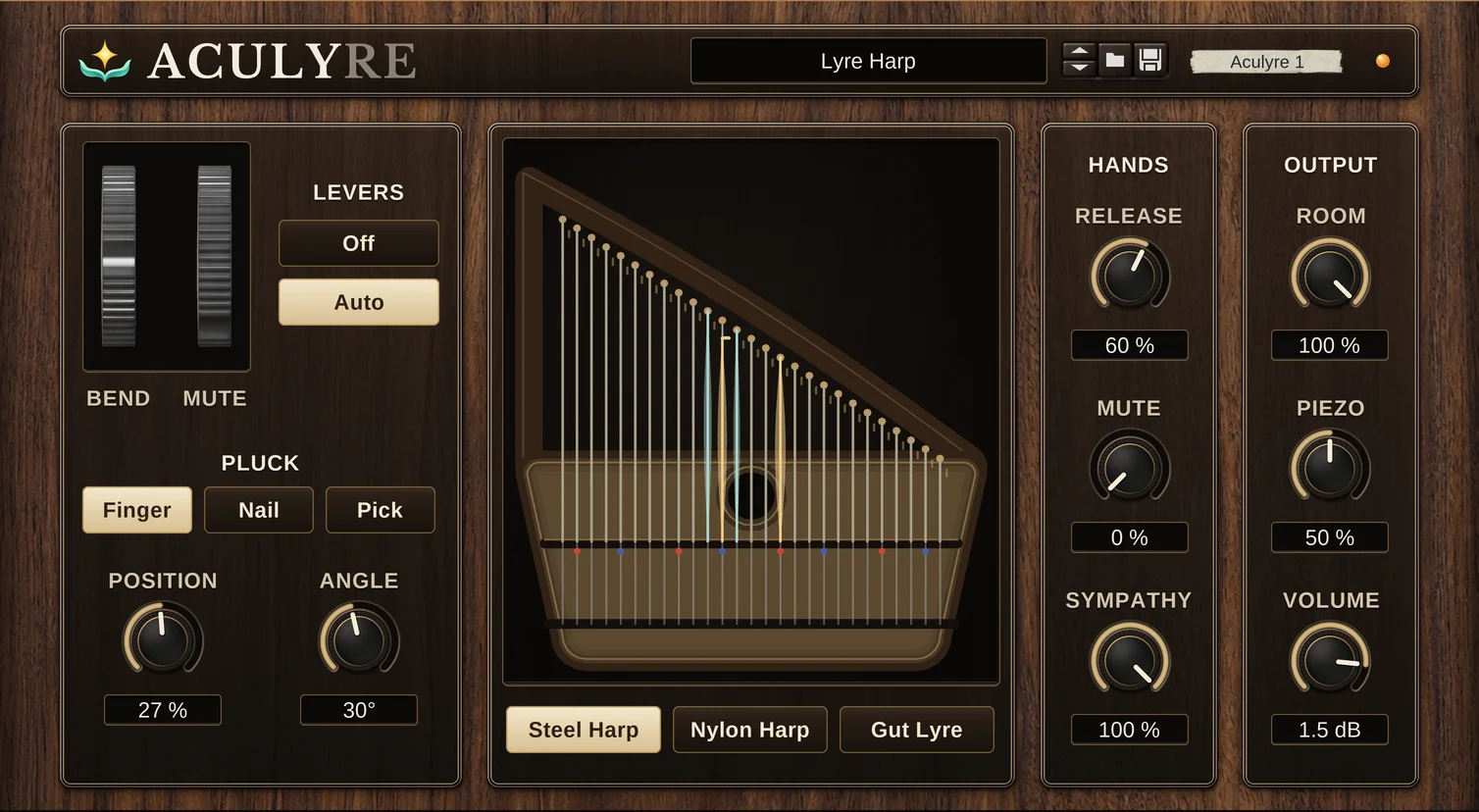
Let a few notes carry the atmosphere. Aculyre brings the clear attack of a steel lyre harp, the softer edge of nylon and the shorter voice of gut into your Reason rack. Use it for a close melodic hook, a rippling arpeggio or a resonant layer around a beat. Every note is generated by physical modelling, with no recorded sample library.
Three instruments with strings that interact. The steel and nylon lyre harps each have 27 strings; the gut lyre has 16. Their strings meet at a shared bridge and soundbox, so unplayed strings can answer in sympathy and the body shapes the decay. The two lyre harps include a vibrating maple back. Turn Sympathy down for a cleaner figure, or leave the strings open to let the harmonies overlap.
Shape the hand behind the sound. Finger, Nail and Pick give the string different releases, from a rounded pluck to a sharper edge. Velocity changes both level and tone, with small variations in force, position and release between plucks. Position and Angle reshape the attack. Release controls how long a note rings after key-up, Mute rests a palm across the strings, and the modulation wheel lets you damp a phrase as you play. Sustain holds plucked strings; pitch bend moves the instrument two semitones either way.
Follow the melody beyond the open strings. Auto levers raise a string by a semitone for chromatic notes. The keyboard range extends below and above each instrument’s string bank by retuning an edge string, so those notes play at their own pitch. Turn Auto off to explore the open-string tuning. The live display shows which strings are held, fading or ringing in sympathy.
Move from air to direct detail. Blend the modelled microphone pair with a piezo pickup under the bridge. Room adds space to the microphone sound, Width sets its spread, and the rear polarity switch changes how the pickup combines with the microphones. Keep a motif close and dry, or give ringing chords a wider setting.
Nine factory patches provide steel, nylon and gut starting points, including soft, damped, picked and piezo voices. Note and Gate CV connect the instrument to rack sequencers, while automation and Remote mapping let your arrangement shape the pluck and resonance. Rear oversampling offers 1x, 2x and 4x processing. Requires Reason 14 or later.
Version history
0.7.9
Adds a vibrating maple back to both lyre harps, changing how their soundboxes resonate. Rebalances the touch across their strings while retaining the established overall output levels.
0.7.7–0.7.8
Refines tuning, the lyre-harp saddle, notes beyond the string bank and repeated plucks. Evens the touch across all three instruments and reduces instrument setup work.
0.7.6
Audio resets now reproduce the behaviour of a freshly created instrument, including its strings, damping and soundbox state.
0.7.5
Expands the steel and nylon lyre harps from 16 to 27 strings. Notes beyond the instrument’s string bank now sound at their own pitch instead of being folded by octaves. The display follows the larger harps.
0.7.4
Extended keyboard playing beyond the open strings by folding out-of-range notes by octaves. This behaviour is superseded by the pitch-preserving extension in 0.7.5.