Modular synthesis has a reputation for being one of the most intimidating areas of music production, especially for beginner and even intermediate producers. Despite its reputation, however, this kind of synthesis is built on a handful of surprisingly straightforward ideas. It uses many of the same fundamental principles that you see in simpler territory like subtractive synthesis, which we’ve outlined here.
Once you understand how signals move through a system and how different modules interact, a modular system becomes much easier to approach.
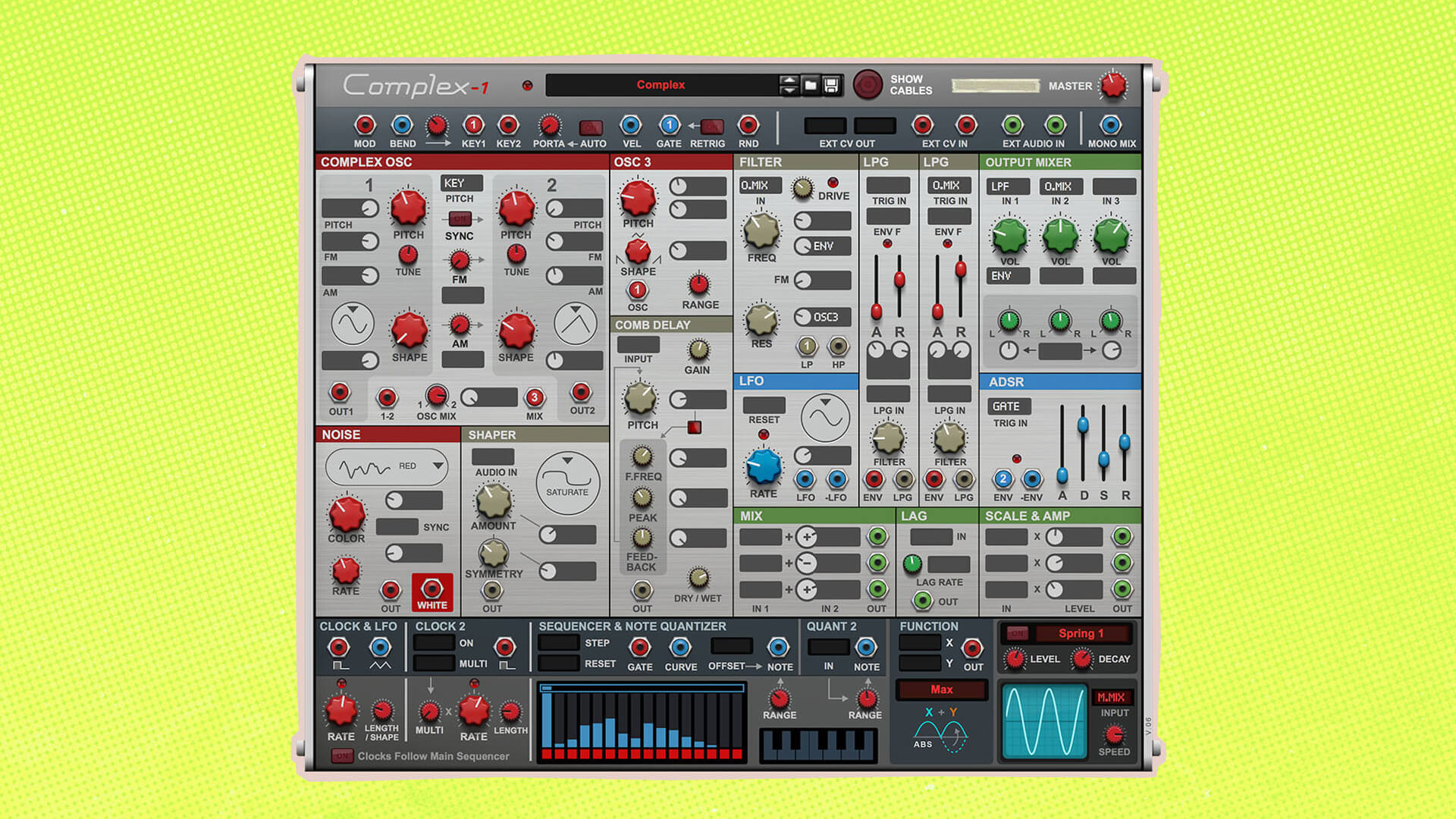
In this guide, we’ll explore the essentials of modular synthesis using Complex-1, the Reason Rack’s go-to modular synth device. Along the way, you’ll learn about signal flow, control voltage, modulation, and everything else you need to build your own patches and use them in your music. Just remember that anytime you’re confused, you can check out the full documentation for Complex-1 here.
Let’s get modular, shall we?
What is modular synthesis?
Modular synthesis is a method of sound creation where individual synthesis components are separated into independent modules that can be connected together in different ways.
In a traditional synthesizer, the signal path is usually fixed. An oscillator goes into a filter, a filter is followed by an amplifier, and modulation sources are usually routed behind the scenes. You can develop the sound, but the overall architecture remains pretty much unchanged.
A modular synthesizer takes a deeper approach. Instead of working with a predetermined signal path, you build the signal flow yourself by connecting modules together. An oscillator can feed a filter. It can also feed a wavefolder, a delay, a mixer, or several destinations at the same time. Modulation sources can be routed almost anywhere, allowing you to create custom instruments and behaviors that would be difficult or impossible in a traditional synthesizer.
This flexibility is one of the main reasons modular synthesis has remained popular for decades. Rather than being limited to a manufacturer’s design choices, you can decide how your instrument works.
Know your modules
Every modular synthesizer is built from individual modules. Some modules generate sound while others shape sound. Some create movement and modulation, while others process or combine signals.
Complex-1 includes a wide range of modules that make it an excellent environment for learning these concepts. Its layout combines traditional subtractive synthesis building blocks with more experimental modular tools, allowing you to explore multiple synthesis approaches within a single instrument.
The modules themselves generally fall into a few broad categories:
- – Sound sources such as oscillators and noise generators create audio signals.
- – Sound shaping modules such as filters, wavefolders, and LPGs (low-pass gates) modify those signals.
- – Modulation sources such as envelopes, LFOs, clocks, and sequencers create movement and control.
- – Utility modules such as mixers, quantizers, comparators, and amplifiers help route, scale, and process signals.
- – Effects and output modules add finishing touches and route the final sound to your speakers.
Before we start patching modules together, it’s important to understand the three main types of signals you’ll encounter.
Audio, CV, and Gate signals
One of the trickiest hurdles for new modular users is understanding that not every signal is audio. In a modular system, many signals exist solely to control other parts of the instrument.
Audio signals
Audio signals, as you probably know, are the sounds you actually hear. Oscillators, noise generators, wavefolders, filters, and effects all process audio signals in some way. If an oscillator is connected directly to a master output, you hear a continuous tone. In Complex-1, modules such as the Complex Oscillator, Oscillator 3, the Noise module, Shaper, Comb Delay, Filter, and LPGs all work with audio signals.
Control voltage (CV)
Control voltage, usually shortened to CV, is used to control parameters. You can think of it as automation, routed with cables. Instead of drawing automation curves in the DAW, a modular system can use one signal to control another. An LFO can move a filter cutoff frequency, an envelope can control volume, or a sequencer can control pitch. You won’t hear CV directly. Instead, you’ll hear the effect it has on the destination it’s controlling.
Gate and trigger signals
Gate and trigger signals tell modules when to do something. When you press a key on your MIDI keyboard, a gate signal is generated. An envelope can use that gate signal to begin its attack stage, a sequencer can use trigger signals to advance through steps, and an LFO can use trigger signals to reset its cycle. In Complex-1, many modules feature dedicated Gate, Trig, or Reset inputs that respond to these types of signals.
Once you understand the difference between audio, CV, and gate signals, modular synthesis starts to make much more sense. Most patches are basically different combinations of these three signal types interacting with one another.
East Coast and West Coast synthesis
As you explore modular synthesis, you’ll often encounter the terms East Coast and West Coast synthesis. These labels refer to two approaches to electronic instrument design that emerged during the early days of commercial synthesizers.
East Coast synthesis, most closely associated with Bob Moog, forms the basis of many common synthesizers. This is where you tend to see the standard waveforms, filters, envelopes, and LFOs that are used in subtractive synthesis.
West Coast synthesis, commonly associated with Don Buchla, tends to place more emphasis on generating complex and unusual timbres at the sound source, as well as developing more organic and experimental behavior. Common techniques include:
- – Frequency Modulation (FM): Using one oscillator to modulate the frequency of another, creating complex harmonic and inharmonic tones.
- – Amplitude Modulation (AM): Using one signal to modulate the volume of another, producing additional harmonics and dynamic timbral changes.
- – Wavefolding: Increasing harmonic complexity by folding a waveform back onto itself rather than removing frequencies with a filter.
- – Low-Pass Gates (LPGs): Modules that combine low-pass filtering and amplitude control, allowing sounds to be shaped with a more natural, organic response.
- – Sequencers and Quantizers: Tools for creating evolving melodic patterns, generative sequences, and controlled variations in pitch and rhythm.
- – Random and Utility Modules: Mixers, comparators, sample-and-hold circuits, and other utility tools that introduce variation, interaction, and complex modulation relationships throughout a patch.
Of course, these two philosophies aren’t dogmatically separate things. They overlap with one another and can both be found in the same instruments, including Complex-1. Its Filter module, ADSR envelope, and familiar signal-routing possibilities make it easy to build patches using an East Coast approach. At the same time, the Complex Oscillator, Shaper, dual LPGs, Sequencer & Note Quantizer, and Clock modules encourage many of the techniques commonly associated with West Coast synthesis.
Learn signal flow by building your first patch in Complex-1
One of the best things about Complex-1 is that it makes signal flow visible. Unlike many fixed-architecture synthesizers, where routing happens behind the scenes, Complex-1 encourages you to think about where signals originate, where they are going, and why they are being routed there. Let’s take a look at the “Canada” patch, which loads when you add Complex-1 to your Rack.
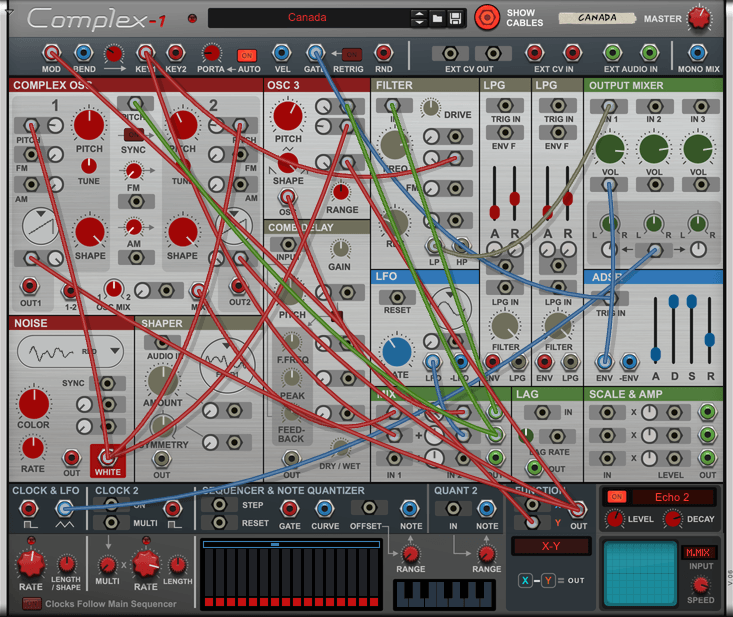
At first glance, this may look overwhelming, but every modular patch is built one small step at a time. At its simplest, a synthesizer only needs a few basic components: a sound source, a way to shape that sound, a method for controlling volume, and a destination for the final signal.
Fortunately, when you reset Complex-1 to the initialized patch, it instantly gives you the simplest possible routing for a basic synth voice. You can do this by right/CTRL-clicking the panel and clicking Reset Device.
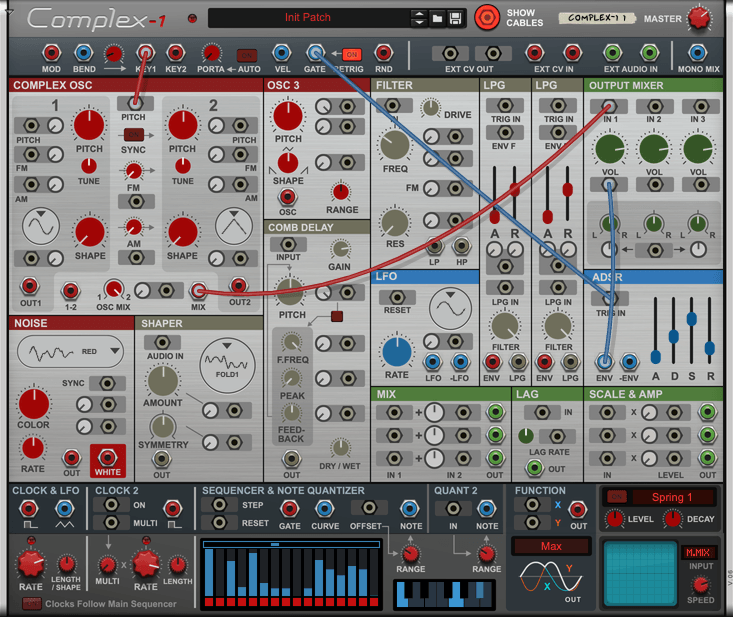
As you can see, it’s now a lot easier to get a sense of how the core components are linked with one another for a basic patch. Take note of how the cables are routed and play a note. The signal flow works like this:
- – Key 1 routes incoming MIDI to the Common Pitch of the Complex Oscillator
- – The Mix output of the Complex Oscillator is routed to In 1 of the Output Mixer
- – The volume of In 1 of the Output Mixer is controlled by the Env output of the ADSR
- – The Trig In of the ADSR is triggered by incoming MIDI via the main Gate input
Although this patch is simple, it demonstrates nearly every core concept in modular synthesis. Pitch information controls the oscillator. A gate signal triggers an event. Audio flows through processing modules before reaching the output. Most modular patches are built from these same principles. Once you understand this basic flow, it becomes much easier to experiment with more advanced routing techniques.
Before we move on, let’s see how the patch sounds when we send the Complex Oscillator through one of the LPGs before it gets to the Output Mixer. In this case, the routing will go like this:

- – Key 1 routes incoming MIDI to the Common Pitch of the Complex Oscillator
- – The Mix output of the Complex Oscillator is routed to the LPG In of the LPG
- – The LPG Out is routed to In 1 of the Output Mixer
- – The Trig In of the LPG is triggered by incoming MIDI via the main Gate input
With this patch, you don’t need to use the ADSR or control the volume of the output with an envelope. This is because an LPG is basically a filter, amplifier, and envelope combined. Try playing some notes while tweaking the Attack and Release times of the LPG.
Don’t forget your utilities…
When most people think about synthesizers, they focus on oscillators, filters, and effects. In modular systems, however, some of the most important modules don’t generate sound at all. These are often called utility modules, and while they can be easy to ignore, they shouldn’t be underestimated!
Complex-1 includes several utility modules that can dramatically expand what a patch is capable of. The Mix module can combine signals, invert modulation sources, or generate static control voltages. The Lag module can smooth abrupt changes and create portamento-style pitch glides. Scale & Amp can be used for amplitude modulation, ring modulation, and signal scaling. The Function module may be the most flexible utility in the entire instrument. It can compare signals, generate sample-and-hold effects, detect pitch from incoming audio, and perform several mathematical operations on control voltages and audio signals.
At first, these modules may seem less exciting than oscillators or filters. As your understanding of modular synthesis grows, however, you’ll often discover that utility modules are what make the most interesting patches possible. They allow you to manipulate signals in ways that go far beyond traditional synthesizer architectures.
Let’s build a patch using the Function module to modify the waveform of the LFO, resulting in a trill-style effect for the pitch of the oscillator. This is a great way to get a glitchy, video game-style sound going in the oscillator.
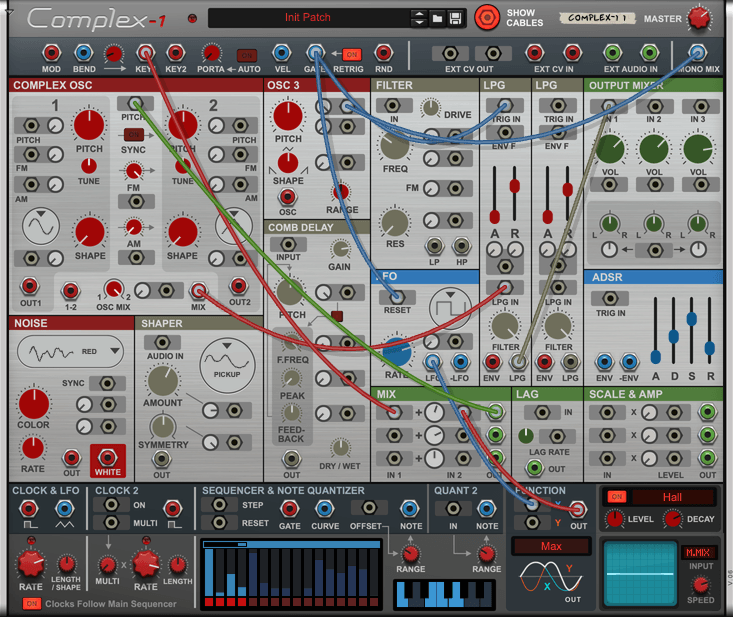
- – Route Key 1 to the top In 1 of the Mix utility module
- – Route the green output of the Mix utility module to the Common Pitch input of the Complex Oscillator
- – Set the LFO to Square and route the LFO output to the X input of the Function module
- – Route a copy of the main Gate input to the LFO Reset input
- – Set the function of the Function module to Max and route its output to the top In 2 of the Mix utility module
- – Adjust the LFO Rate and the attenuverter of In 2 in the Mix utility module to taste
- – Adjust the Frequency Modulation (FM) amount in the Complex Oscillator to taste
Let’s hear how it sounds:
Here the attenuverter of the Mix utility module (the grey knob beside the In 2) allows us to control how drastic we want the change in the pitch of the oscillator to be, while the rate of the LFO controls how fast that change happens. Meanwhile, the FM control of the Complex Oscillator allows us to get a more rich and distinctive timbre going.
You’ll notice that when we play a note, no matter how high we set the attenuverter in the Mix module, the root frequency of the oscillator stays the same, while the higher frequency gets higher. This is because the Max function of the Function module is ensuring that only the maximum value of the LFO is passing through.
Get dynamic with sequencing and modulation
One of the biggest advantages of modular synthesis is the ability to create interesting forms of change and movement. Rather than programming every change manually, you can build patches that continuously evolve on their own. Complex-1 includes several tools that make this easy to explore.
The Sequencer & Note Quantizer module can generate melodic patterns, rhythmic sequences, and repeating control voltages. By connecting the Note output to an oscillator’s pitch input, you can create melodic sequences without drawing MIDI notes in your DAW. The Quantizer allows control voltages to be constrained to specific notes within a scale. This makes it easier to experiment freely while remaining musical.
Meanwhile, LFOs, envelopes, and clock modules can continuously modulate parameters throughout the patch. Filter frequencies can drift. Waveforms can evolve. Effects can change over time. The result is often a sound that feels more organic and alive than a static patch.
As an example, let us once again modify our previous patch, this time to be played by the sequencer rather than an incoming MIDI note. To bring the sequencer into the equation, modify our existing patch like this:
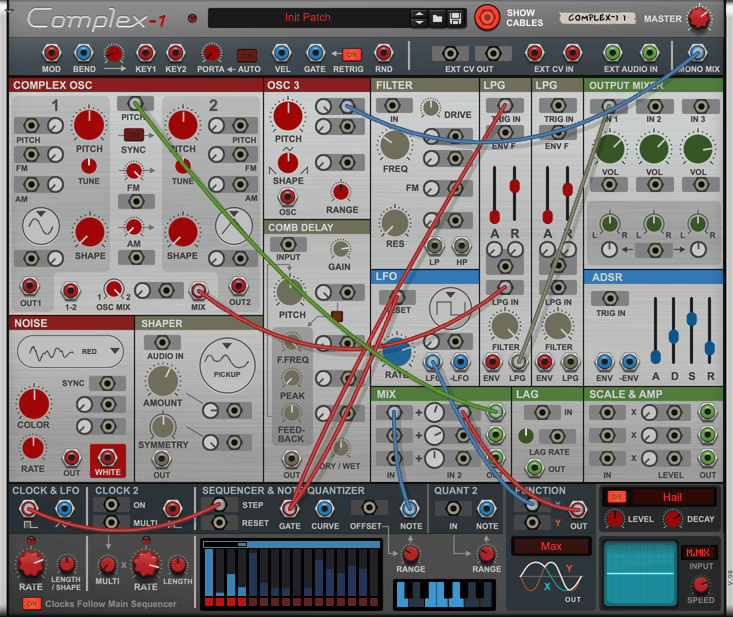
- – Route the Clock signal in the Clock & LFO module to the Step input of the Sequencer
- – Route the Gate output of the Sequencer to the Trig In of the LPG and the LFO Reset
- – Route the Note output of the Sequencer to the In 1 of the Mix utility module
- – Turn on Clock Follows Main Sequencer in the Clock module
When you hit play in the DAW, you’ll hear the sequence as it’s programmed by default. You can adjust the CV values in the Sequencer Display and quantize those values to the notes you select with the Keyboard Display so that the sequencer only outputs notes that you want it to. You can also adjust the Rate in the Clock module to change the time division at which the sequence plays.
If you’re wondering how to introduce more movement when you only have one LFO, we have some good news! The Ext CV In input allows you to bring in two CV signals from other devices in the Rack via the back panel, so we recommend adding a Pulsar Dual LFO to upgrade your modulation.
Below is an example of a sequence we’ve programmed with our main example patch as the basis, plus the addition of some unique harmonics with the Shaper module (modulated by an external CV signal from Pulsar), a bit of reverb, and some delay from Ripley Space Delay. We’ve also made some adjustments to the LFO rate and in the Complex Oscillator to get the right frequency content. Modulating the oscillator pitch at the highest speed gives us some excellent tones for an old-school Detroit techno-style synth line.
Even simple modulation assignments can produce surprisingly complex results when multiple sources interact, so we highly recommend experimenting with these elements of Complex-1 to see what’s possible.
Explore more advanced modular ideas
As your confidence grows, modular synthesis opens the door to techniques that are difficult to achieve in many traditional synthesizers.
Random modulation is one example. Using the Noise module together with the sample-and-hold function in the Function module, you can generate stepped random voltages that change over time. These signals can be used to modulate pitch, filter frequency, effect parameters, or almost anything else in the patch.
Audio-rate modulation is another powerful technique. Because many parameters in Complex-1 can be modulated at audio rates, oscillators can directly influence filters, wavefolders, and other oscillators. This often creates complex, distorted, and glitchy textures that would be difficult to produce through conventional subtractive synthesis alone.
Feedback is another area where modular systems become particularly interesting. Complex-1 even includes a Mono Mix routing option that can feed signals back into the system for experimental processing and evolving textures. Just don’t route that directly to an input in the Output Mixer!
These techniques can seem intimidating at first, but they all build on the same concepts you’ve already learned. Signals are simply being routed in more creative ways.
Why Complex-1 is a great way to learn modular synthesis
Hardware modular systems can be inspiring, but they can also be expensive, space-intensive, and difficult for beginners to navigate. Complex-1 offers many of the same concepts in a much more accessible environment. Every module is visible. Signal routing is easy to follow. Connections can be created, modified, and removed instantly. You can experiment freely without worrying about hardware limitations or purchasing additional modules.
Just as importantly, Complex-1 combines multiple synthesis traditions within a single instrument. It can teach the fundamentals of subtractive synthesis while also introducing concepts like wavefolding, low pass gates, complex modulation routing, and generative sequencing. That makes it an excellent learning tool for producers who want to understand modular synthesis without immediately diving into the world of Eurorack hardware.
Follow the modular way
Modular synthesis looks intimidating with all the overlapping cables and apparent complexity. But it’s actually more intuitive than it appears. Most importantly, we think, it’s a way of making sound that rewards curiosity and experimentation.
Traditional instruments give you a fixed set of controls and expect you to work within them, but modular flips that around. You can build a basic synth voice, then completely change how it behaves if you feel like it. A filter doesn’t have to filter. A sequencer doesn’t have to just sequence pitch. Even the humble utility modules can turn a throwaway idea into something that breathes and evolves. Some patches, of course, won’t work at all, but a wrong turn can lead somewhere you may not have thought to go deliberately.
Complex-1 is a good place to start exploring all of this without buying a rack full of hardware. Classic subtractive stuff, West Coast weirdness, generative sequences that kind of take on a life of their own. It handles all of it, and it’s forgiving enough to actually learn on. Start simple, change one thing, and see what happens. The rest tends to follow!
Ready to make music with Reason?
Frequently Asked Questions
What is modular synthesis?
Modular synthesis is a method of creating sound by connecting individual modules together. Each module performs a specific function, such as generating audio, filtering frequencies, creating modulation, or controlling volume.
How does a modular synthesizer work?
A modular synthesizer works by routing audio, control voltage, gate, and trigger signals between modules. Unlike a traditional synthesizer with a fixed signal path, modular synthesis allows you to decide how each part of the instrument is connected.
Is modular synthesis difficult to learn?
Modular synthesis can look complicated, but its core concepts are relatively straightforward. Beginners can start with a basic patch containing an oscillator, an envelope or low-pass gate, and an output, then gradually add modulation and effects.
What is control voltage in modular synthesis?
Control voltage, commonly called CV, is a signal used to control a parameter within a modular synthesizer. For example, an LFO can send CV to a filter cutoff, while a sequencer can send CV to control oscillator pitch.
What is the difference between CV, gate, and audio signals?
Audio signals produce the sounds you hear. CV signals control parameters such as pitch, volume, and filter frequency. Gate and trigger signals tell modules when to perform an action, such as starting an envelope or advancing a sequencer.
What modules do you need for modular synthesis?
A basic modular synth patch usually requires a sound source, such as an oscillator, a module for shaping the sound, a way to control volume, and an output. Filters, envelopes, LFOs, sequencers, mixers, and utility modules can then be added for more complex sound design.
What is the difference between East Coast and West Coast synthesis?
East Coast synthesis generally uses oscillators, filters, envelopes, and amplifiers in a subtractive signal path. West Coast synthesis places more emphasis on tools and techniques such as wavefolding, frequency modulation, low-pass gates, sequencing, and complex modulation.
What is Complex-1?
Complex-1 is a modular synthesizer device for the Reason Rack. It combines subtractive synthesis tools with features such as a complex oscillator, wave shaping, low-pass gates, sequencing, modulation, utility modules, and flexible signal routing.
Is Complex-1 good for beginners?
Complex-1 is a useful way to learn modular synthesis because its modules and cable connections are visible within a single software instrument. Beginners can reset it to a simple initialized patch and explore new routing ideas without purchasing hardware modules.
Do you need hardware to learn modular synthesis?
No. Software instruments such as Complex-1 let you learn signal flow, patching, control voltage, sequencing, and modulation without investing in a physical modular or Eurorack system.
How do I get Complex-1?
Complex-1 comes included with Reason+, the Reason DAW, and the Reason Rack Plugin. Once you install Reason, you can access Complex-1 directly from the Reason Rack without purchasing it separately.