Subtractive synthesis is one of the most common and influential forms of sound synthesis ever created. It is responsible for countless basses, leads, pads, plucks, and arpeggios heard across genres ranging from classic rock and funk to techno, house, synth-pop, and hip-hop.
If you’ve ever opened a synthesizer and seen controls labeled Oscillator, Filter, Envelope, or LFO, there’s a good chance you’ve been looking at a subtractive synth.
The good news is that subtractive synthesis is also one of the easiest synthesis methods to learn. Once you understand a few fundamental concepts, you’ll be able to approach a huge range of synthesizers with confidence.
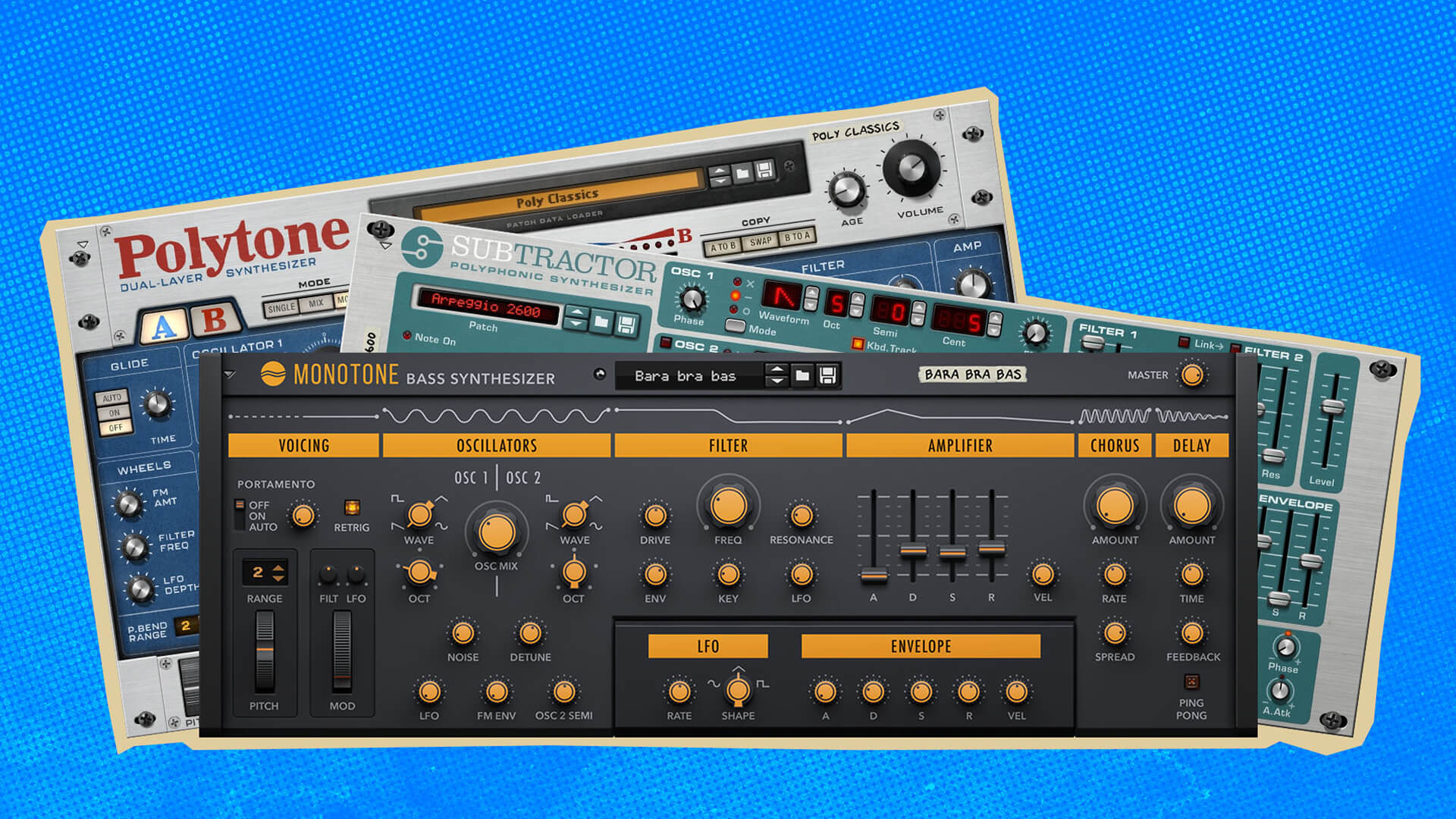
In this guide, we’ll explore what subtractive synthesis is, how it works, and how you can learn it using three Reason Rack instruments: Monotone, Subtractor, and Polytone.
What is subtractive synthesis?
Subtractive synthesis creates sounds by starting with harmonically rich waveforms and removing frequencies until the desired sound is achieved.
The name comes from the fact that you’re subtracting frequencies from a sound rather than adding them
Most subtractive synthesizers begin with one or more oscillators generating raw waveforms.
Those waveforms are then shaped by filters, envelopes, and modulation sources until they become musical sounds.
A bright sawtooth wave can become a warm bass. A square wave can become a vintage synth lead. The same oscillator can be transformed into a pad, a pluck, or a sound effect simply by changing how the signal is processed.
At its core, subtractive synthesis is all about sculpting.
The building blocks of subtractive synthesis
Although subtractive synthesizers come in many forms, most are built around four essential components:
1. The oscillator generates the raw sound.
2. The filter removes frequencies and shapes the tone.
3. The envelope controls how the sound changes over time.
4. The LFO introduces movement through modulation.
Once you understand how these four elements interact, the signal flow of most subtractive synthesizers starts to make sense.
Reason’s go-to subtractive synths — Monotone, Subtractor, and Polytone — are perfect for getting a handle on these concepts and putting them into practice, especially since they gradually increase in complexity.
So, let’s start with the most simple one and work our way up from there!
Learning the fundamentals with Monotone
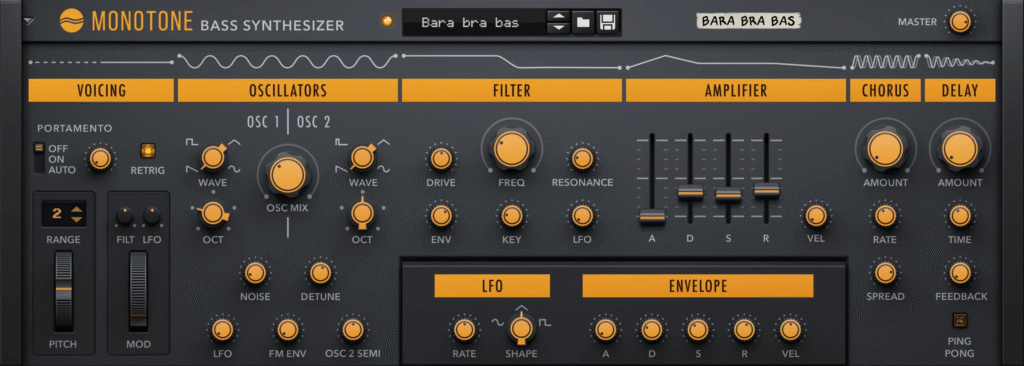
Monotone is one of the best synths for understanding the basics of subtractive synthesis because its architecture is straightforward and focused.
It features two oscillators, a classic low-pass ladder filter, amplifier and modulation envelopes, an LFO, and built-in chorus and delay effects. Everything is laid out in a simple left-to-right signal flow.
When learning synthesis, this kind of simplicity is a huge advantage.
Start by selecting a saw wave and holding a note. A sawtooth waveform contains a large number of harmonics, which gives it a bright and aggressive sound. Next, turn the Filter Frequency control down. As the cutoff frequency moves lower, the high-frequency harmonics begin to disappear and the sound becomes darker.
This single exercise demonstrates the core idea behind subtractive synthesis.
You begin with a rich sound source and remove frequencies until you arrive at the tone you want.
Now increase the Resonance control and repeat the process. You’ll hear frequencies around the cutoff point become more pronounced. This creates the vocal, squelchy character heard in many classic synth sounds.
Next, move to the amplifier envelope. Set a fast attack and short release for a punchy bass sound. Then increase the attack and release times to create something more gestural and atmospheric.
Without changing the oscillator at all, you’ve already created multiple completely different sounds.
Finally, introduce a small amount of LFO modulation to the filter frequency. This is when the sound begins to move in a more organic way.
At this point you’ve learned the four core concepts of subtractive synthesis: oscillators, filters, envelopes, and LFOs.
Here’s a basic example to show what all of that looks like in action:
An in-depth guide to Monotone can be found here.
Taking the next step with Subtractor
Once you’re comfortable with the fundamentals, Subtractor shows how subtractive synthesis expands into a deeper sound design environment.
At first glance, Subtractor can look much more intimidating than Monotone. It includes two oscillators with dozens of waveform options, dual filters, multiple envelopes, two LFOs, frequency modulation, ring modulation, and extensive modulation routing.

The important thing to understand is that the underlying principles haven’t changed.
You’re still generating sound with oscillators. You’re still shaping that sound with filters. You’re still using envelopes and LFOs to control how the sound evolves over time.
Subtractor simply gives you more ways to manipulate each stage of the process.
For example, its dual-filter architecture allows you to create more complex timbres than a traditional single-filter synth. You can combine different filter types and frequencies to sculpt sounds in ways that would be impossible with a simpler instrument.
The modulation system also demonstrates an important lesson about subtractive synthesis. As synthesizers become more advanced, the core signal path often remains familiar while the modulation possibilities expand dramatically.
Subtractor’s additional envelopes and LFOs allow sounds to become more dynamic, expressive, and animated. You can create subtle movement, evolving pads, aggressive basses, and intricate leads while still relying on the same subtractive foundation you learned in Monotone.
In our video example below, we can hear how Subtractor’s fundamental wave shaping setup allows for expanded possibilities when it comes to the timbre of the sound you’re starting with.
We’re also increasing the amount of modulation coming from two LFOs. One of these is routed to the phase of the oscillators, which results in a kind of warbly chorus-like effect, while the other is routed to the filter cutoff frequency and synced to global tempo, giving us a rhythmic tremolo-like effect.
An in-depth guide to Subtractor can be found here.
Exploring modern subtractive synthesis with Polytone
Polytone represents another step forward.
Like Monotone and Subtractor, it is fundamentally a subtractive synthesizer built around oscillators, filters, envelopes, and modulation. However, it introduces several modern features that demonstrate how far the subtractive approach can be taken.
The most obvious feature is its dual-layer architecture.
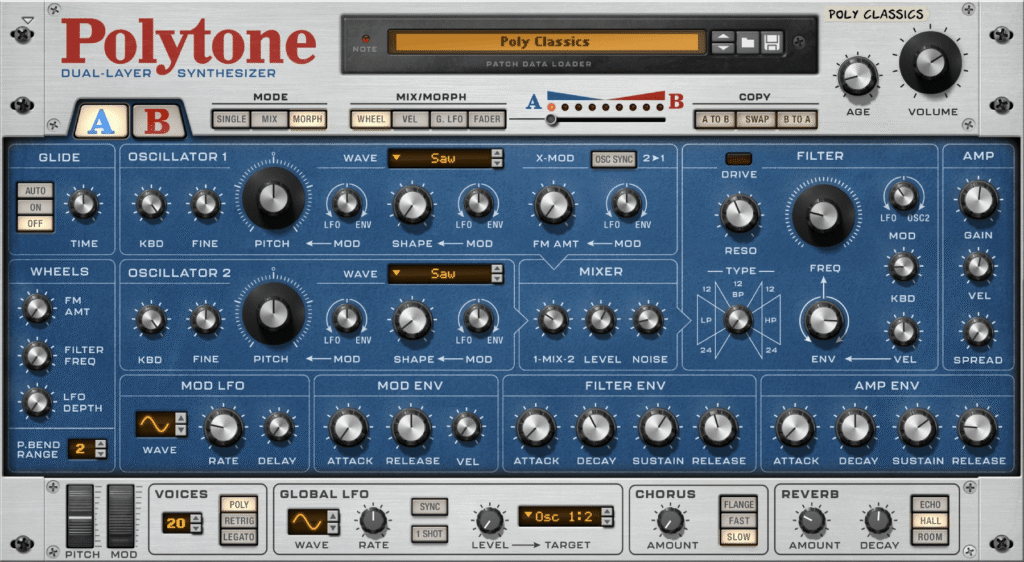
Polytone contains two complete synth layers, Layer A and Layer B. These layers can be played individually, mixed together, or morphed between.
This makes it possible to create sounds that evolve dramatically over time while still relying on classic subtractive synthesis techniques.
For example, you might build a warm analog pad in Layer A and a brighter version in Layer B.
By morphing between the two layers, the synth gradually changes character while maintaining a coherent musical identity.
Polytone also introduces more advanced oscillator and filter techniques. The oscillators feature waveform shaping, oscillator sync, and frequency modulation. The filter can continuously transition between multiple filter responses rather than forcing you to select a single fixed type.
These features create a huge amount of tonal flexibility, but they’re still built on the same subtractive concepts you learned in Monotone.
The oscillator generates harmonics. The filter shapes them. Envelopes and LFOs create movement. The architecture becomes more sophisticated, but the core ideas remain unchanged.
Here’s an example where Layer A holds a brighter pad sound with much of its low-frequency content filtered out, while Layer B holds a sine-based pad with a more resonant quality to it. When we set the layering configuration to Mix and modulate the slider with the LFO, we get some pretty unique movement that sounds a bit more distinctive than a typical filter modulation.
An in-depth guide to Polytone can be found here.
Why filters matter so much
If there’s one lesson that connects all three synthesizers, it’s the importance of the filter.
Beginners often focus on oscillator waveforms because they’re easy to hear. More experienced sound designers often spend most of their time working with filters and modulation.
That’s because the filter is where much of a subtractive synth’s personality comes from.
A bright saw wave passed through a low-pass filter can become a warm bass. Increase the resonance and it becomes more vocal. Add an envelope and it becomes punchy and expressive. Add an LFO and it starts to move.
The oscillator provides the raw material, but the filter is usually where the magic happens.
A practical subtractive synthesis project
By this point, you’ve learned the core ideas behind subtractive synthesis. Now let’s put them into practice with a simple three-part arrangement.
Start with Monotone and create a bass sound using a saw wave, a low-pass filter, and a short envelope. This gives you a solid low-end foundation and demonstrates the classic subtractive signal path in its simplest form.
Next, pull up the 70s Synth Lead preset in Subtractor. Take note of how it uses the two oscillators and take a moment to shape the tone with the filter. The result should cut through the mix while showing how subtractive synthesis can become more expressive as you add more modulation options.
In our example, we’ve also added some chorus from Quartet, delay from The Echo and reverb from RV-9 Reverb Station.
For the final layer, pull up the Poly Classics preset in Polytone. Change the Mode setting to Mix, change the Mix/Morph modulation source to the Global LFO, and slow the rate of the LFO down. This makes use of both layers to build a wide, warm sound. In our example, we’ve also changed the oscillator type to Digital on both oscillators in Layer B so that there’s more timbral contrast between layers.
On top of this, we’ve used the Granular mode of RV-9 to add even more movement and nuance to the sound. This is incredibly useful for making dynamic, immersive pads.
Now play all three instruments together. Monotone provides the bass, Subtractor handles the lead, and Polytone fills out the harmony. Even though each sound serves a different purpose, they’re all built using the same subtractive synthesis principles you’ve learned throughout this article.
Once you can hear how these three sounds work together, you should have a solid understanding of how subtractive synthesis is used in real-world music production.
Going further with subtractive synthesis
One of the reasons subtractive synthesis has remained popular for decades is that it’s both accessible and incredibly flexible.
The basic idea is simple. Start with a harmonically rich sound and remove frequencies until you arrive at the tone you want.
Yet that simple concept is capable of producing an enormous range of musical results.
Whether you’re creating a bass in Monotone, exploring advanced modulation in Subtractor, or building evolving dual-layer sounds in Polytone, you’re still working with the same fundamental principles.
Once those principles click, you’ll discover that most subtractive synthesizers share a common language. Learn that language, and an entire world of sound design opens up!
Ready to make music with Reason?