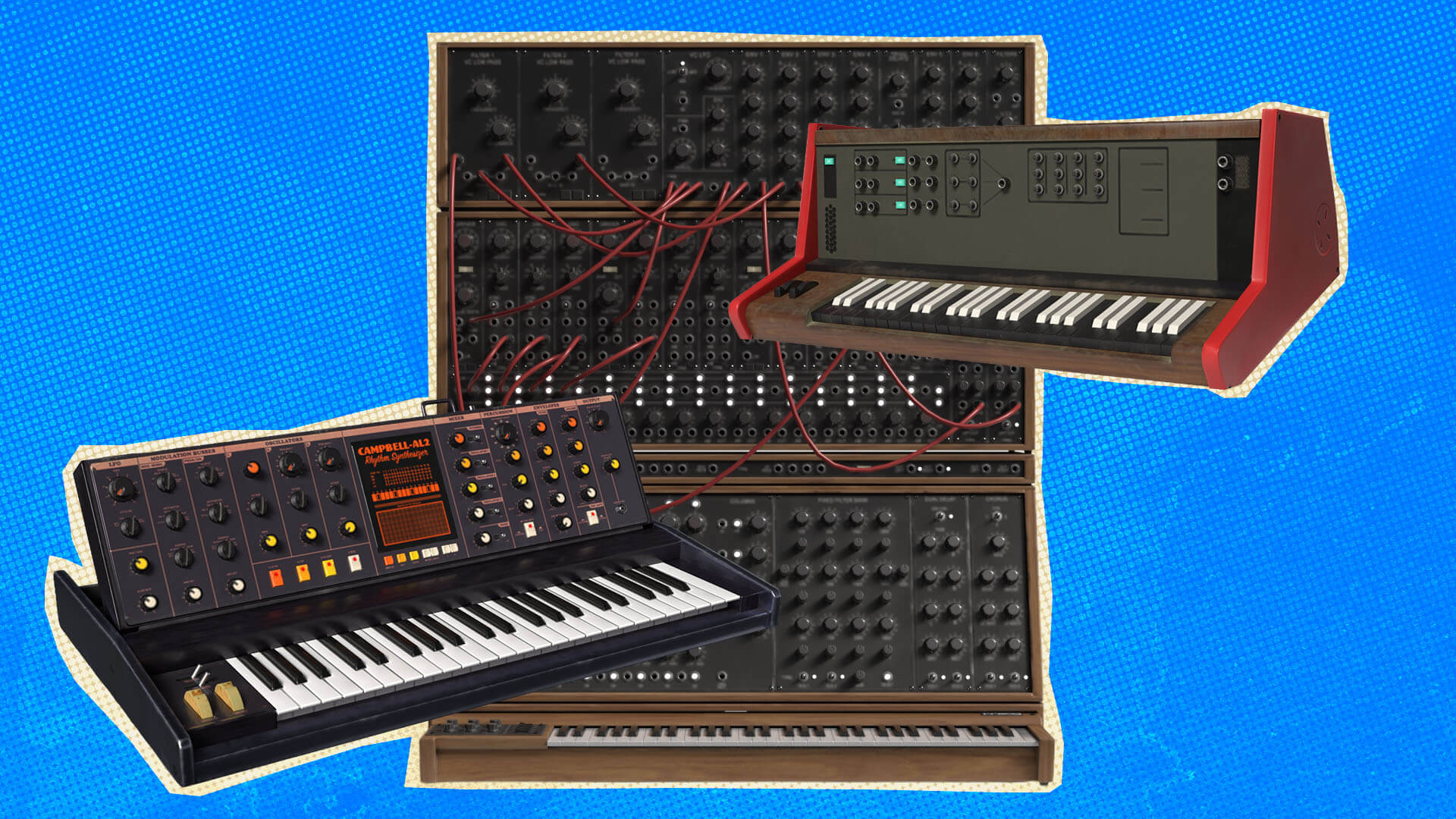
There are many types of synthesizer out there, and each of them allows you to explore a particular range of sonic possibilities.
If you’re a beginner, this can be a bit daunting. A lot of the Reason community is intimately acquainted with the various types of synth and how to use them, but we’ve also got new music-makers joining the fam all the time. So, we thought we’d put together a primer on synthesis that anyone can use.
The Reason Rack has a device for every major type of synthesizer. This means that even if you don’t use the Reason DAW, adding the Rack plugin to your production toolbox means adding a whole slew (you’ll appreciate that pun one day) of synthesis-based instruments that all sound fantastic and are a joy to use. We’ll make use of them throughout this guide, and the links to the instrument pages on our site will provide you with further resources on understanding how it works.
With all of that said, let’s synth it up shall we?
What is a synthesizer?
A synthesizer is an electronic musical instrument that creates and shapes sound using either analog circuitry or digital technology.
Early synthesizers relied on analog voltage-based systems to produce sound, while many modern synthesizers generate audio digitally, whether in software or hardware form. Most synthesizers use some combination of analog and digital circuitry, and some even take a hybrid approach by combining digital sound sources with analog signal paths.
While synthesizers are commonly played using piano-style keyboards, they can also be controlled by sequencers and other input devices. In the Rack, one of our favorite ways to sequence synthesis-based instrument devices are with the Player devices.
Synths can either be monophonic (only one note can be played at a time), polyphonic (more than one note can play at a time), or paraphonic (the sound source can be played using chords but all notes move through one signal path). Most synthesizers are designed around the standard Western chromatic scale, though many modern instruments support alternative tuning systems and microtonal scales.
As we mentioned, there are many different types of synthesizer available, each offering its own sound characteristics, creative possibilities, and approach to sound design. This article will focus on the ones you’re most likely to encounter these days. If you want a deeper introduction to how synthesis works, check out this article from LANDR.
Subtractive synthesis
What is subtractive synthesis?
Subtractive synthesis creates sounds by starting with harmonically rich waveforms and using filters to remove frequencies until the desired sound is achieved.
When using a subtractive synth, you’ll tend to see oscillators that offer sawtooth, square, triangle, and pulse waveforms, while the filters will typically offer standard low-pass, band-pass, and high-pass types. The structure of a typical subtractive synth will usually give you one to three oscillators, one filter (sometimes two), one or two envelopes for shaping the dynamics of the sound, and one or two LFOs for modulating certain parameters through some kind of modulation routing system.
Subtractive synthesis is particularly suitable for bass, lead, pad, and arpeggio sounds that you often hear in classic techno and hip-hop, ’70s and ’80s rock and pop, as well as funk and psychedelic. However, it’s the type of synthesizer with perhaps the most timeless sound, it can be used in just about anything.
Three subtractive synth devices that you’ll find in the Rack are Monotone, Polytone, and Subtractor. All of them follow a pretty classic analog-style architecture, with Monotone being a monophonic bass synth and the other two being polyphonic.
Below is an example of a simple patch in Monotone (using its built-in chorus and delay effects), sequenced with a monophonic pattern programmed in PolyStep Sequencer. As we sweep the filter, you can see how the brightness of the sawtooth and square waveforms come through:
Here’s another example where the polyphonic subtractive synth Polytone is played with Chord Sequencer and run through Quartet for a bit of chorus. Again we can see how sawtooth and square waveforms are good for upfront, brassy sounds:
Wavetable synthesis
What is wavetable synthesis?
Wavetable synthesis generates sound by scanning through a collection of waveforms, creating evolving and dynamic timbres.
When using a wavetable synth, you’ll typically find oscillators loaded with “tables” that contain dozens or even hundreds of related waveforms. Most wavetable synthesizers also include filters, envelopes, LFOs, and modulation systems that allow you to move through the wavetable and continuously change the character of the sound over time.
Wavetable synthesis is particularly well suited to modern electronic music, where evolving pads, aggressive basses, expressive leads, and complex textures are common. This unique type of synthesizer is especially popular in genres such as EDM, dubstep, future bass, and techno, though its versatility makes it useful for almost any style of music.
Here’s an example of a lush arpeggio in Europa, a particularly powerful synth Reason Rack device for wavetable synthesis:
As the chord progression plays, you can see us sweeping the wavetable position to get some pretty significant and unique variation in timbre.
Additive synthesis
What is additive synthesis?
Additive synthesis builds sounds by combining multiple simple waveforms, usually sine waves, to create complex tones. It also often makes use of wavefolders and other effects or circuits which add harmonics to the starting waveform rather than remove them.
This type of synthesizer is typically centered around a large number of harmonics that can be individually adjusted in level and sometimes frequency. Many additive synths also include envelopes, filters, and modulation options, allowing users to shape how the harmonics evolve over time and create everything from simple tones to highly detailed sounds.
Additive synthesis is particularly useful for creating evolving pads, organ-like sounds, bells, and detailed textures. Because it offers precise control over a sound’s harmonic content, it is often used in sound design, ambient and experimental music, EDM, and cinematic production, though it can also be used to create more traditional instrument sounds.
Here’s an example of an arpeggio (generated with Arpeggio Lab) using Parsec 2, one of the go-to additive synths for the Rack:
When we sweep the X control of the B Modifier, you can hear how the sine wave partials in the sound source are altered based on the algorithm of the modifier. In other words, a lot of timbral variation and complexity is possible through just algorithmic control of sine tones alone.
Granular synthesis
What is granular synthesis?
Granular synthesis manipulates audio by breaking it into tiny fragments called grains and rearranging or processing them in real time.
When using a granular synthesizer, you’ll usually work with audio samples that are divided into hundreds or thousands of small grains. Most granular synths provide controls for grain size, density, pitch, position, and playback speed, along with modulation tools that can dramatically transform the source material into entirely new sounds.
Granular synthesis is particularly well suited to atmospheric textures, evolving soundscapes, and experimental effects. It’s one of the more common types of synthesizer used in modern ambient, cinematic, and electronic music, where its ability to stretch, fragment, and reshape audio can create sounds that would be difficult to achieve with other synthesis methods.
Check out this pad sound that was made using Grain Sample Manipulator:
The playhead of the sampler is scanning very quickly through a string sample to give it a more dynamic and otherworldly feel. The grain model being used is Spectral Grains, which allows us to change the formant qualities of the grains for a distinctive, smeared sound.
FM (frequency modulation) synthesis
What is FM (frequency modulation) synthesis?
FM (frequency modulation) synthesis creates sound by using one oscillator to modulate the frequency of another at audio-rate speeds, producing complex harmonic content.
The structure of a typical FM synthesizer consists of multiple operators, with each operator usually being a pair or group of oscillators that have certain modulation relationships with one another. These operators are arranged in different configurations called algorithms, which determine how they interact. Most FM synths also include envelopes and modulation controls that allow for precise shaping of the resulting sound.
FM synthesis is particularly suitable for electric pianos, bells, plucks, basses, and metallic sounds. It became an especially popular type of synthesizer during the 1980s and remains widely used in electronic music, video game soundtracks, and modern production where bright, detailed, and expressive sounds are needed.
The example below, using the Rack’s main FM synth Algoritm, gives a sense of how even simple tones can lead to unique results in an FM patch:
As the arpeggio plays, you can see in the algorithm routing section that we’re changing how different operators are routed to one another, which can change the timbre significantly.
Physical modeling synthesis
What is physical modeling synthesis?
Physical modeling synthesis uses mathematical models to simulate the behavior of real instruments and acoustic objects, creating realistic and expressive sounds.
When using a physical modeling synthesizer, you’ll typically encounter parameters that control characteristics such as material, tension, resonance, damping, and excitation. Rather than relying on recorded samples, these synthesizers generate sound in real time by simulating the physical processes that produce vibrations in strings, tubes, membranes, and other resonant objects.
Physical modeling synthesis is particularly effective for recreating acoustic instruments while still allowing sounds to go beyond what is possible in the real world. It’s the ideal type of synthesizer for expressive strings, winds, percussion, and experimental instruments, making it popular among sound designers, composers, and electronic musicians alike.
In the example below, we use two instances of Objekt to demonstrate a pair of percussion sounds that are being sequenced separately:
The parameters in the Collision, Pitch Mod, Dispersion, and Damping sections allow us to both create realistic percussion sounds and take them beyond their natural limits for musical effect. This is because the impact of the virtual surface is being emulated in as detailed a way as possible, with maximum control.
Multi-engine synthesis
What is multi-engine synthesis?
Multi-engine synthesis combines multiple synthesis methods within a single instrument, offering a wider range of sounds and greater flexibility.
The structure of a multi-engine synthesizer varies depending on the instrument, but it typically includes several sound engines that may use subtractive, wavetable, FM, granular, sampling, or physical modeling techniques. These engines can often be layered, split, or routed together through shared filters, effects, modulation systems, and performance controls.
Multi-engine synthesis is particularly useful for musicians who want access to a wide variety of sounds without switching between multiple instruments. This type of synthesizer excels at creating layered textures, complex patches, and hybrid sounds, making it a popular choice for modern production of just about any genre, not to mention film scoring and live performance.
Among the devices in the Reason Rack, Thor is the multi-engine synth par excellence. Here’s an example of a dreamy pad sound:
This particular patch makes use of three different forms of synthesis at once: subtractive, phase modulation (similar to FM) and wavetable. The three main sound sources are routed through two different filters, and as we adjust the octave and filter controls, we can see how much variation is possible when multiple synthesis modes are used at once.
Modular synthesis
What is modular synthesis?
Modular synthesis creates sounds using separate modules that can be connected in different ways, allowing music-makers to build custom signal paths and unique instrument behavior.
A modular synthesizer typically consists of individual modules such as oscillators, filters, envelopes, LFOs, sequencers, and effects. Instead of relying on a fixed signal path, users connect these modules with patch cables to determine how audio and control signals flow throughout the system.
Modular synthesis is particularly suitable for experimentation, sound design, and creating highly customized instruments. It is widely used in electronic, ambient, techno, and experimental music, where its flexibility allows musicians to discover unique sounds and workflows that are difficult to achieve with conventional synthesizers.
Complex-1 is the Rack’s MVP when it comes to modular synthesis. Let’s take a look at a patch that uses its built-in sequencer:
Because modular synthesis is so open-ended and involves a wide range of modulation sources, it allows us to create single patches which contain multiple independent layers operating at once. The sequencer is also paired with a pitch quantizer and scale selector that ensures we stay within certain scale boundaries, which is great for leaning into a bit of “controlled chaos.”
Going further with Reason Rack
As you can see, all of these common types of synthesizer are covered beautifully by the synth-based instrument devices that come with the Rack, and we haven’t even covered all of them here.
But the Rack isn’t just about the quantity of instruments and other devices that are included. It’s about how these devices work with each other. You can start with a synth patch, sequence it with Players, process it with effects, route modulation across devices, and build sounds that feel like custom instruments in their own right. That sense of connection is what makes the Rack such a deep and inspiring place to explore synthesis, whether you’re just getting started or already know your way around a patch cable.
In future articles we’ll be delving deeper into all of these synthesis types using each of the Rack instruments you’ve seen here, so keep an eye out for those tutorials.
In the meantime, give the Rack plugin or the Reason DAW a try if you haven’t already!
Ready to make music with Reason?